
By Dr. Bob Ainsley, Past President, New Bern Chapter – SAR, Guest Writer for Tryon Palace
The first provincial congress in America was held in the Craven County Court House, New Bern, NC from August 25-27, 1774. It was a significant contribution to the Revolutionary movement. Seventy-one delegates representing 30 of 36 counties and 6 of 9 boroughs met to discuss grievances against taxes and laws imposed on the Colonists by the Royal Crown and the British Parliament. They agreed on 28 resolves focused on non-importation, non-exportation, and non-consumption economic sanctions against Great Britain and its trading partners if demands were not met. Richard Caswell, William Hooper and Joseph Hewes were elected as delegates to the 1st Continental Congress in Philadelphia between September 5, and October 26, 1774. They were instructed to present the resolves to the 1st Continental Congress as actionable redress of grievances.
The New Bern Resolves had a significant influence on the “Articles of Association” at the 1st Continental Congress. The Articles of Association or “The Association” was one of the first attempts at redressing grievances against the Royal Crown and British authority. Committees of Safety were established throughout the provinces to enforce the sanctions and citizens were strongly encouraged to sign an oath of allegiance in support of the Association. Shortly after the 1st Continental Congress 51 ladies of Edenton signed a petition on October 25, 1774, supporting “The Association” to boycott English tea and English cloth. Penelope Barker, the leader of the “Edenton Tea Party,” states publicly “Maybe it has only been men who have protested the king up to now. That only means we women have taken too long to let our voices be heard. We are signing our names to a document, not hiding ourselves behind costumes like the men in Boston did at their tea party. The British will know who we are.” Women involved in politics was unheard of during this period and they risked their lives in signing the petition.
These events polarized colonists loyal to the Crown (“Loyalists”) and patriotic colonists dedicated to American Liberty. Loyalty to the British Crown and support for American Liberty among the citizens of North Carolina pitted family against family; friend against friend; and neighbor against neighbor. One notable story of the time is that of Currituck County Delegate Thomas McKnight at the Second NC Provincial Congress held in New Bern, NC during April 3-7, 1775. Thomas McKnight, a wealthy Loyalist planter and landowner in the Albemarle and Upper Cape Fear areas, was involved in shipbuilding and export trade in Norfolk, Virginia and was the only delegate that did not support “The Association” at the Second NC Provincial Congress. Consequently, he was chastised by the remaining delegates as “inimical to the Cause of American Liberty” and had to flee for his life to the protection of Governor Dunsmore of Virginia. Thomas McKnight eventually fled to England never to return while losing his land, ships, property, and merchandise valued at 30,000 British Sterling ($8 million in today’s dollars).
The period between “The Intolerable Acts” (1774) and the Battles of Lexington and Concord (1776) was a tumultuous time throughout the American colonies. North Carolina Patriots were quick to act and voice their support for American Liberty, also. Patriots in the Mecklenburg, North Carolina area (many who attended the 1st and 2nd NC Provincial Congresses) wasted little time in making their opinions known by publishing the Mecklenburg Resolves on May 20, 1775 that stated the authority of the King and Parliament are null and void and that the Continental Congress is the authority in America. The date “May 20, 1775” is immortalized as one of two dates on the current North Carolina state flag. Other North Carolina areas responded with fervent resolve:
May 31, 1775 – The Newbern Association issued a call to arms and pledge allegiance to the “cause”
June 19, 1775 – The New Hanover County Resolves issued a “Call to Arms”
June 30, 1775 – The Cumberland County Resolves issued a “Resist Force by Force”
July 1, 1775 – The Pitt County Resolves issued a “Resist the Several Arbitrary Illegal Acts of Parliament”
August 1775 – Tryon Resolves issued a “British Provocation Drove People of North Carolina to Armed Resistance”
During this timeframe additional North Carolina Provincial Congresses were held. The 3rd NC Provincial Congress took place in Hillsborough, North Carolina from August 20 to September 10, 1775. The delegates declared the NC Provincial Congress as the temporary government of North Carolina after the dissolution of the Royal Colonial Assembly; established a 13-member Provincial Council to act as an executive body; divided the province into seven military districts for militia organization and representation in the Provincial Council; and ordered the enlistment of the first two units of Provincial Troops. North Carolina was preparing for armed conflict. The 4th North Carolina Provincial Congress was held during April 4, to May 14, 1775, at Halifax, North Carolina and on April 12, 1776, the 83 delegates unanimously adopted the “Halifax Resolves” instructing the North Carolina delegates to the 2nd Continental Congress to vote for independence from Great Britain. The date “April 12, 1776” is immortalized as the other date on the current North Carolina state flag. The 5th North Carolina Provincial Congress was held during November 12, to December 23, 1776, in Halifax, North Carolina and is also known as the 1st North Carolina Constitutional Convention. The delegates wrote and adopted the first North Carolina Constitution including a Declaration of Rights that would later play a significant role in the ratification of the US Constitution and Bill of Rights. The delegates established one of the most elaborate judicial system within the provinces and elected Richard Casewell as the first governor of North Carolina.
A commemoration for the 251st Anniversary of America’s First Provincial Congress will be held on Saturday, August 23, 2025, 9:30 – 11:00 a.m. on the Tryon Palace South Lawn in New Bern, NC. The event aims to honor the bravery of the 71 delegates and the importance of the 1st NC Provincial Congress in North Carolina and American history, particularly its significance toward the outcome of the “Articles of Association” and the American Revolution.
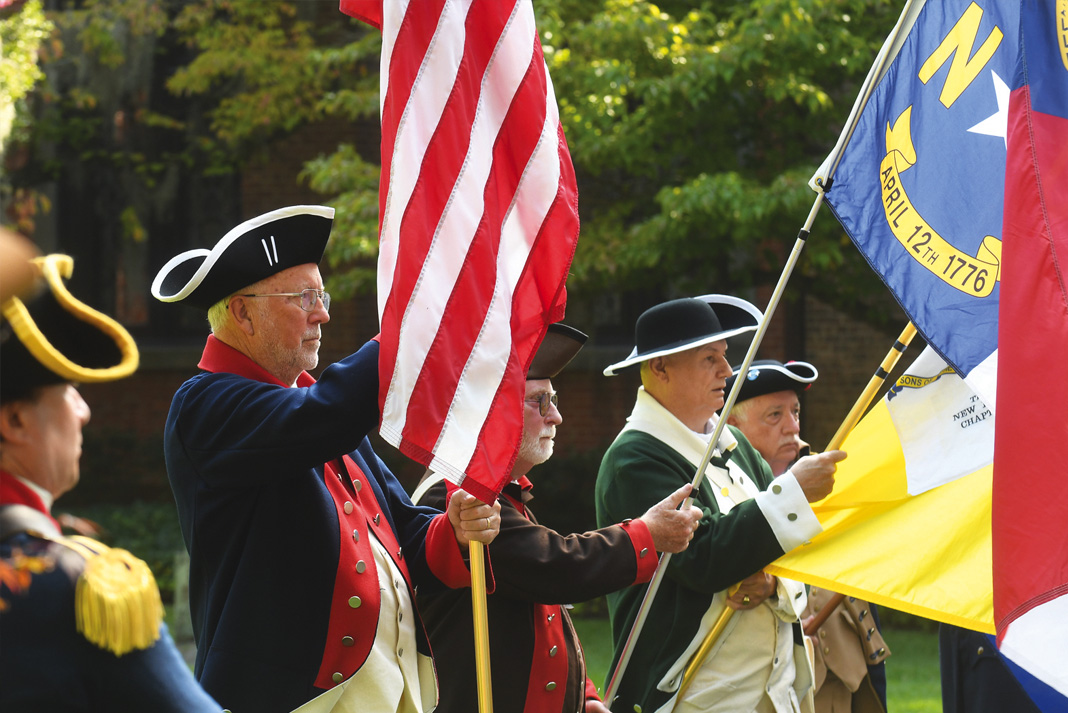
On Saturday, August 23, 2025, at 9:30 a.m., a procession will move north on Metcalf Street from the North Carolina History Center through the Tryon Palace Front Gates on Pollock Street to the Palace’s South Lawn. The procession will include members of the Tryon Palace’s Fife & Drum Corps, Sons of the American Revolution, Daughters of the American Revolution, St. Johns Masonic Lodge #3, the SAR Color Guard, Scouting America, National Sojourners “Heroes of 1776,” Scottish Rite, York Rite and other patriotic and civic organizations.
The ceremony at the Tryon Palace Historic Site will include a keynote address by North Carolina Senator Bob Brinson, District 3. It will conclude with a rendering of honors for the 71 Delegates and Resolves of the 1st North Carolina Provincial Congress.
In the event of inclement weather, the event will be conducted with limited seating at the Harrison Center, 311 Middle Street, New Bern, NC.