
by Edward Ellis, Special Correspondent

At the time of the American Revolution, New Bern was crowded with Frenchmen. So many were inhabiting the town that travelers complained of a shortage of lodging and overcrowded taverns.
Some of the French came for adventure. Some for glory. Some as soldiers of fortune. But all were willing to aid the colonial Patriots’ fight for independence while poking a stick in the eye of a perennial enemy – The British.
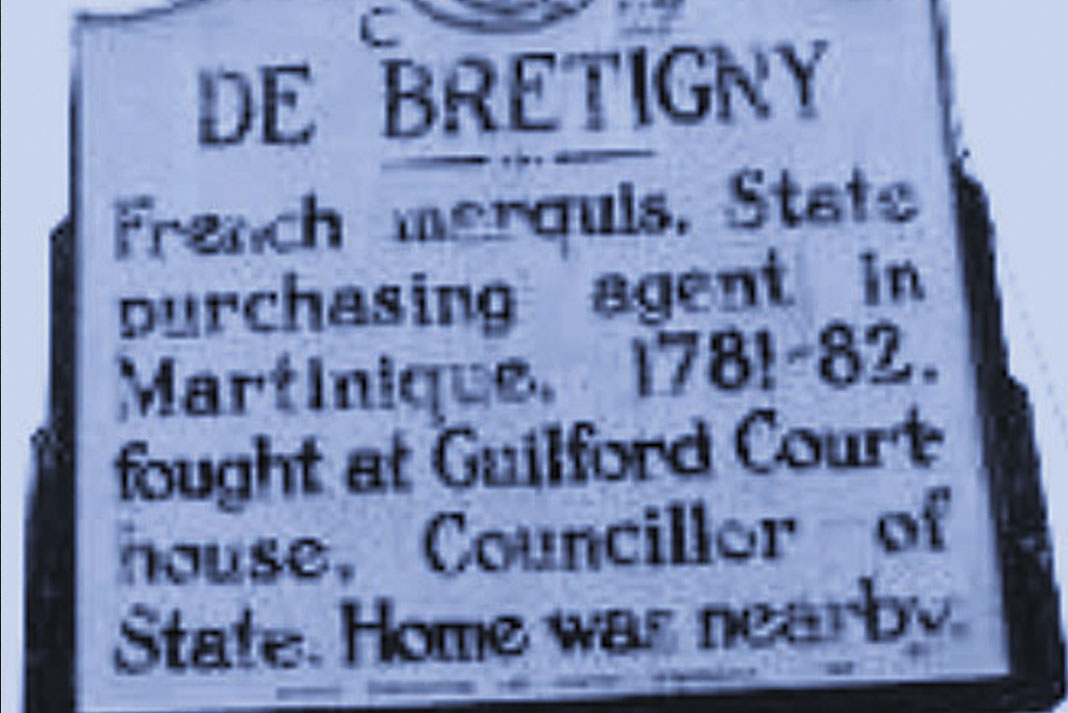
One of the rich sons of France who became well known here in North Carolina’s colonial capital was Charles Francois Sevelinges. Sevelinges, who styled himself “The Marquis De Bretigny,” held a high military rank in his home country as part of the bodyguard for the king’s brother.
He came to America in 1777 with soldiers and arms for a regiment of cavalry. Unfortunately, his force was captured by British frigates. He was imprisoned for six months in St. Augustine before making his escape to Philadelphia. The marquis corresponded with George Washington and Benjamin Franklin and petitioned unsuccessfully to the Continental Congress for a commission as a brigadier general.
It seems the national stage was already full of French generals like the famous Lafayette so De Bretigny offered his skills to North Carolina. Arriving in New Bern in September 1780, he was soon appointed as the state’s purchasing agent to the French West Indies. Among his war exploits, he commanded cavalry at the pivotal Battle of Guilford Courthouse. He later served in the Council of State.
From his New Bern home, De Bretigny was honored by the governor and general assembly for his contribution to the struggle for independence. He was commended for “his zeal to serve this State in particular, in the hour of danger.”
During the French Revolution, which began in 1789, De Bretigny lost his vast familial fortune. He is said to have died “poor and in debt” during a 1793 trip to Philadelphia. He was 39.
A record in local court minutes shows that the year before his death he had taken on the apprenticeship of a twelve-year-old boy to teach him the trade of baker. This fact left local historian A. T. Dill to wonder if the marquis “had been reduced to keeping a bakery shop.” The place of his burial is unknown.