
by Edward Ellis, Special Correspondent
An old letter from New Bern to a merchant shipowner in Vermont preserves the record of a devastating hurricane that passed directly over this city on August 1-2, 1795.
It reads: “A most tremendous gale came from the north-east on Saturday night, and about south-east on Sunday morning, which lasted until 2 o’clock P.M. during which time all the vessels were either called away, or upset and sunk: – You have heard of the severe gale in Carolina in the year 1769; but this was worse.”
An excerpt of the letter was published about a month later in Spooner’s (Windsor) Vermont Journal. The writer told the merchant, “Your brig Adventure lies in the woods a mile from the water; the Snow Betsey lies in the marshes; these two with a brig from Boston, and a sloop of Capt. Butler’s will be lost … All the wharves in the harbor are torn up and ruined. All the lumber is dispersed to about three miles in the country.”
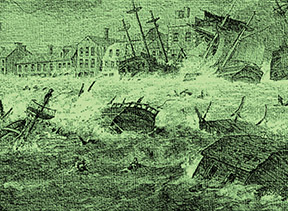
The writer reported that “Edward Tinker, Stephen Tinker, Ellis Derraur, & Wilson Blount’s Ware Houses, and all the Ware Houses of the estate of Singleton are gone. The damage on this occasion is supposed to be more than that of all three fires put together.”
[A few months ago in this column, we wrote about a devastating 1791 fire – caused by bartenders – that destroyed most of New Bern. Here is another reference to that fire – plus two more of the late 1700s.]
The writer noted that most of the houses along the river “are gone,” but told the unidentified Windsor, Vermont merchant that his New Bern “store and ware-house is standing.”
“The largest trees are torn up by the roots,” the letter writer said. “The worst is that all the corn in the country and all the hogs have been destroyed. Your scow lies in Bergen’s cornfield opposite his house. The water has been at 15 feet perpendicular of the low water mark. The country (around New Bern) lost all its crops; there will not be sufficient corn for its consumption. All the fruit trees, or at least the fruit, is blown down by the wind.”
Brigs, snows, and sloops are types of ships. A scow is a flat-bottomed boat for local freight hauling. None of them fared well at the port of New Bern during the disastrous hurricane and flood of 1795.