
By Claudia Houston, New Bern Historical Society
March is not only Women’s History Month but it is also the anniversary of the Battle of New Bern. At the time of the Battle, Sarah Elizabeth Harvey was a twelve-year-old girl residing with her family on Pollock Street. In 1937, at the age of eighty-six, she was interviewed by the New Bern Sun Journal and described what she witnessed on the day of the Battle of New Bern, March 14, 1862, and during the Union occupation.
Sarah described how, on the day of the battle, her father, employed at a local distillery, left home for his workplace, hoping to protect the firm’s rosin and turpentine. Sarah remembered that as her father left, he told her to hide whatever valuables she could to keep them out of Union hands. Although the battle was fought several miles from the city, the cannon fire could be heard throughout the morning. She remembered that two shells struck the city that day, one hitting a church and one landing in a field.
By noon, the Union soldiers had broken through the Confederate lines, and many were retreating through town via Pollock Street. Soldiers and citizens were setting fires to many of the town’s buildings, some of which burned to the ground. Sarah vividly remembered Collison Ford Hughes, a local citizen, trying to convince the citizens not to set fire to the town. She quoted Mr. Hughes as saying, “For God’s sake, men…don’t burn up our village. It’s all we’ll have. We’ll have to come back here when the war is over. What you leave now is all you’ll have to come back to. “
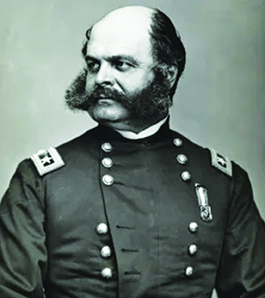
Sarah noted that the Union soldiers arriving in town worked for hours to extinguish the fires. She recalled that when General Burnside arrived, he issued strictly enforced rules that governed his men’s behavior and posted soldiers on every street corner to maintain order.
Sarah’s mother was sitting on their front porch when General Burnside approached her, pulled money out of his pocket, and asked whether she could help feed his men. Her father offered to get supplies from a nearby store, and her mother then cooked ham, biscuits, and coffee for the soldiers. Liberal pay was given to those who were able to obtain supplies. To provide for their family, Mrs. Harvey frequently fed the soldiers and others in her home, and Mr. Wood took fish in a wheelbarrow to the local camp to sell.
Sarah remembered her family being forced to move from their neighborhood as many residents were opposed to the Harvey’s feeding Union soldiers in their home.
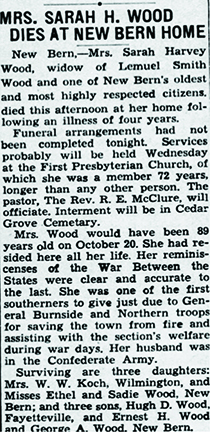
Sarah Harvey remained in New Bern, marrying Lemuel Smith Wood in 1870 and raising six children. Mr. Wood had served in the Confederate Army with Company K of the 2nd North Carolina Infantry. Sarah, though eighty-six years old when granted this interview, recollected names, places, and events during the war period and occupation. Historical records verify that Sarah’s recollections were accurate. Sarah was gratified that the Union Army maintained law and order and saved New Bern from destruction by fire.
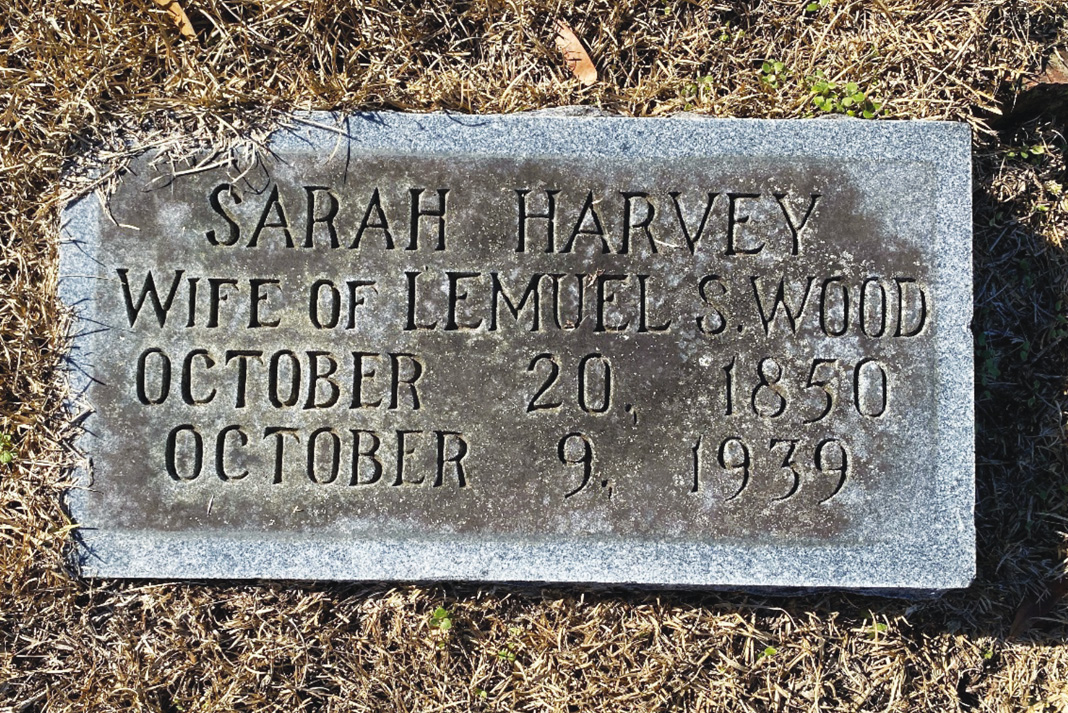
Sarah died on October 9, 1939, at the age of eighty-eight. She was remembered as one of the city’s oldest and most respected citizens. Along with her parents, husband, and other family members, Sarah is buried at Cedar Grove cemetery.
Sarah Elizabeth Harvey Woods’s eyewitness accounts have provided a fascinating and unique look back in time.