
By Jonathan Burger, Craven Arts Council & Gallery, Inc.
Where are you from and how’d you end up in eastern North Carolina?
I am from Aurora, NC. Born in Washington, DC, I don’t remember much because my parents moved to Aurora with family when I was a toddler.
Do you have any formal training as an artist, or are you self-taught, or a combination of both?
Art is a God-given gift. I discovered it at the age of six and began to draw with pencil every day after that. It was effortless; whenever I tried drawing something new, I pretty much would discover things on the fly. As I grew older, I explored apparel and sneaker customization, not because I had a passion for it, but because my parents couldn’t afford to buy me the school clothes I wanted. Customization was when I first started using acrylic paint. I painted on clothes and shoes and started to understand how to use different paint brushes in relation to paint. I went from doing simple color changes on shoes to creating full detailed multicolored designs on shoes, pants, and shirts. Not only that, but I wore a customized t-shirt to a college scholarship interview and used it as a talking point to get a scholarship for college.
Training did not come about until I reached adulthood. Before I went into training/mentorship, I took the initiative to do a deep study on color for two years. I wanted to begin to understand the relationship between all colors. I made this choice on my journey to transition from a black and white pencil, pen, and charcoal artist. I never painted on canvas as an artist prior to meeting Edward Lee Hood. Who became a lifelong mentor after my first attempt to paint something in one of three of his downtown studios. I thought working in acrylics on canvas would be a piece of cake, but I found out quick that techniques had to be learned to create textures and many other subtleties that go into a painting. From that day forth, I dedicated 6 hours daily to learn every technique under the mentorship of Edward Lee Hood and pick up a few extra on my own along the way.
Does your work have a central theme, or several themes?
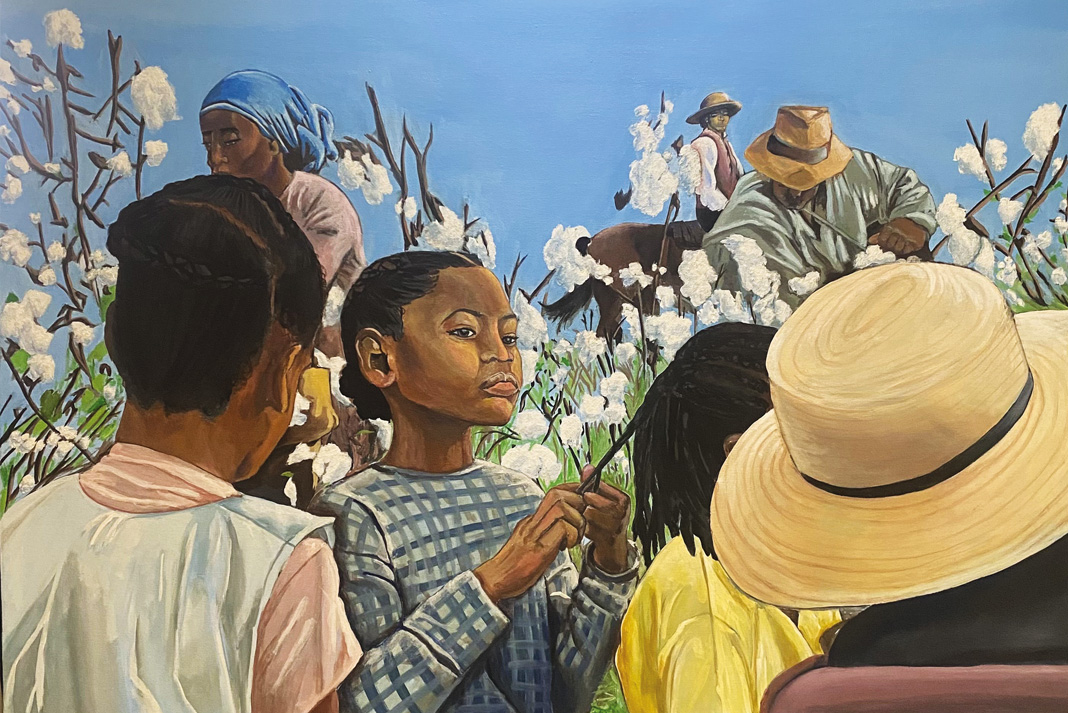
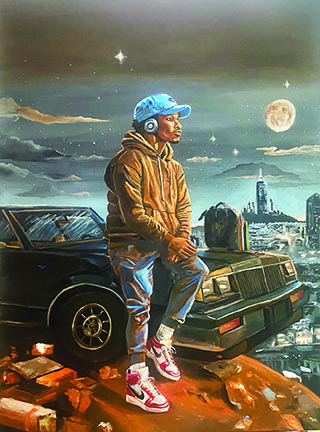
My art has several themes. I like my art to be relatable and have a narrative for the black culture, our history, and the trends we create.
I know you work in both traditional painting and digital media. What relationship do you see between these mediums, and how are they different?
Working in traditional painting will always be my go-to. In traditional painting, I have a more personal relationship with it. I’ve learned so many techniques and am still discovering things today. Digital media was another skill I wanted to learn because it’s a big part of the art world in these current times. I found you can make a digital painting look like a traditional painting in half the time. The differences are physical tools vs. digital tools, and being able to create textures for the touch with traditional cannot be obtained in digital art. For me, I will always choose traditional over digital because you could handicap yourself and lose the physical touch you develop in traditional painting by becoming too dependent on the short cuts of digital media.
You’ve been an artist in our Juneteenth exhibition since 2019, but this year you’ve assumed the role of co-curator. What’s that been like and how is it different from the artist side?
Assuming the role of co-curator has helped me develop the characteristics of a leader. Taking on such a leadership role is a great responsibility and will quickly highlight those areas that need attention in your personal development. It’s different from the artist side because you see what it’s like to have to build relationships with all types of artists. Aside from that, I became more sensitive to their needs, as far as providing them with all the information they need and gaining their trust as their curator. Also, feeling the same pressure they feel when art has to be completed by a certain date. Managing people and making sure an art show has a good turnout is pressuring but exciting because art is my gift and passion. In conclusion, the role has been a revelation, and I grew a great deal of respect for it; the artist is and will always be in my best interest.
Who is another artist whose work you admire or inspires you?
I do admire a lot of artists work, but I don’t follow or keep records of names. I simply analyze a technique they did that I want to try and keep it moving. I’m inspired by my last painting, only to continue to challenge myself daily.
What one piece, award, or exhibition are you particularly proud of, and why?
I’m proud of the “Ain’t yo’ Momma” piece that sold right away in the 2022 exhibition. The 2022 Juneteenth Exhibition is also something I’m proud of. The sold piece and show both were when I knew what direction I wanted to take in art. I had finally found my niche and felt it was time to walk in my calling.
What advice do you have for new artists or people wanting to get into the arts?
My advice for new artists or people wanting to get into the arts is that there is a market out there for everyone if you want to make a living out of it. First, give yourself time to develop your craft; in doing so, focus on those areas you are the least strong in.
I know you curating and participating in the Juneteenth exhibition at Bank of the Arts, but where else can people find you work?
People will soon be able to find and purchase my art in an online store. (Link to be posted on social media platforms.@ Diamond Styles)