

By Jonathan Burger, Craven Arts Council & Gallery, Inc.

Where are you from and how did you end up in eastern North Carolina?
I am a Canadian, I grew up in Montreal and on the east coast of Canada. After graduate school, I lived in the United Arab Emirates for several years teaching printmaking, photography and drawing. It was East Carolina University that lured my husband and I to eastern North Carolina, where we have been since 2005.
Where did you go to school?
I was incredibly fortunate to have two amazing mentors as I studied printmaking. The first was Daniel Dingler at the University of Windsor, Canada, who taught me to break all the rules when it came to art making, the second was Beauvais Lyons, my mentor for my Master of Fine Arts in Printmaking at the University of Tennessee, Knoxville, who taught me about discipline and how to control my medium.
Is there a central theme to you work, or several themes?
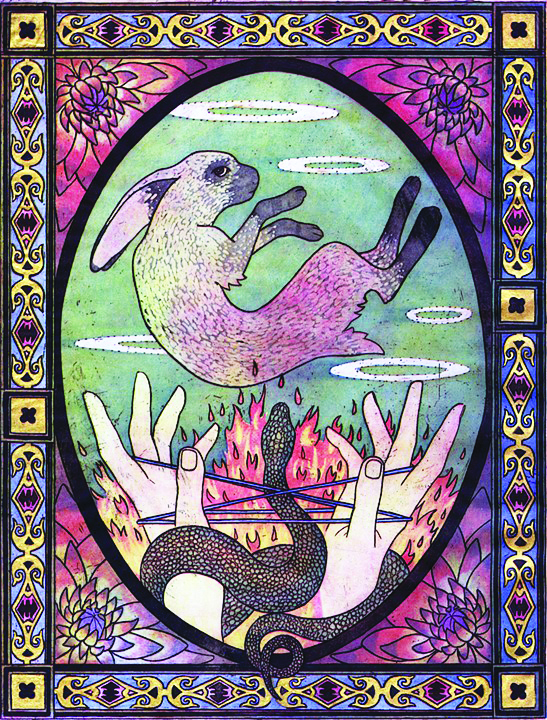
I like to work in several themes at once, there always seems to be something new that piques my interest. However, I would say that whatever the current theme or series may be, I do tend to approach my work in a way that uses symbology, mythology, humor, and mystery to create works that suggest connections or relationships to the viewer rather than straight forward narratives.
You teach printmaking, including a lot of the traditional forms like lithography, woodcut, and engraving. What is important about these traditional methods in an era when “digital prints” have become so popular?
While I do use digital tools often in the ideation process, I find that when I start to work on my prints, I consciously avoid the use of any digital tools whatsoever. It feels important to me that I honor the traditions and materials of printmaking by using the same techniques that artists have been using for centuries. For me, working by hand rather than digitally, serves as a mediation and the physicality of working a plate or using the printing press creates a relationship with the work that I don’t find using digital tools.
Do you have a favorite technique or medium for your work, and why?
I enjoy working in all forms of printmaking as well as fibers and textiles, though right now I would have to say that I am really enjoying working with copper etching as my preferred medium. Etching is an incredibly versatile technique that allows for modern interpretations and adaptations while still maintaining a timeless quality to the finished works.
Is there an artist whose work you admire or inspires you?
While there are many printmakers whose work I admire, lately, I have been watching videos of Japanese craftspeople at work, whether they are potters, weavers, printmakers or calligraphers. I am deeply interested in the Japanese concept of “kaizen” of continual improvement in the pursuit of perfection. I find it helpful to often look to artists outside of my discipline for inspiration and for new ways of looking at things.
Do you have any advice for artists just starting out or people wanting to get into art?
Being an artist is hard work. To be a successful artist you must work at your practice continually, you cannot wait for inspiration or the mood to strike you. In the ECU printmaking studio, we like to say “work comes from work” meaning that the more artwork you create the more you will learn and more you will want to create. The act of working on your art practice every day keeps your creative instincts honed. This work occurs on many levels, from continually practicing and improving on your technique, developing new concepts or ideas to explore, working on marketing your artwork, maintaining websites and online stores, to working with galleries and shipping art work.
What artwork, exhibition, or award are you particularly proud of, and why?
“Visual Elegy” is a project that means so much to me. I was invited to join a group of twenty-six printmakers from twenty different states to contribute work to the project. Each artist was asked to make a print inspired by the poetry collection, “Appalachian Elegy”, and its author, acclaimed social activist, feminist theorist, artist, bell hooks, who wrote that “(t)he function of art is to do more than tell it like it is—it’s to imagine what is possible.” It was an honor to work collaboratively with a group of artists that I so deeply admire.
In sentence, what is art to you?
Art is the closest that many of us get to a meditation or a place of calm. I find great comfort in the repetitive processes that are involved in so much of my art making, whether it be printing an edition, hand stitching, crocheting, or making small marks on an etching place. These processes allow me to be both physically creative by the act of tangibly producing an artwork, but it also allows for the quiet mental space to be creative and observant in my thoughts.
I know you’ll have a piece in ROY G BIV as the juror, but where else can people find your work?
My website heathermuise.com has many images of my present and past work, while my Instagram account @lazymusepress has more frequent updates that include images of my process and projects that are still in progress.