

By Jonathan Burger, Craven Arts Council & Gallery, Inc.
Where are you from and how’d you end up in Eastern North Carolina?
I was born and raised in Carteret County and have lived there my entire life. I grew up in Marshallberg and now live there with my wife and two children.
Do you have any formal training, or are you self-taught, or a combination?
I started drawing at an early age, but didn’t take art seriously until high school. I had six art classes while a student at East Carteret High School and went on to get my BFA in Art Education at East Carolina University.
You are a teacher yourself, what relationship do you see between teaching and your artwork?
In an effort to reach as many different types of emerging young artists, in class we try to expose students to as much art history as possible and as many different types of art making as possible. In doing so, it has really given me so many more influences to draw from and incorporate into my own work. The students themselves are also such a huge motivating and inspiring factor. They are up to date with all sorts of new ideas, artists, and techniques. The internet has really transformed the art world in that way. So, they push me to be creative in ways I wouldn’t normally go. It’s also important to keep my skills sharp for them and they enjoy knowing they have a teacher who can’t just talk the talk.
Is there a central theme to your work, or several themes?
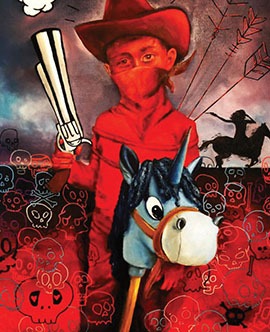
The hardest thing post-college was figuring out what kind of artist I wanted to be. When you don’t have a professor telling you “This is the assignment…”, it’s hard to pinpoint where to go. For a long time I dabbled in portraiture, following in the footsteps of artists I admired, trying to learn. My wife and kids have been my biggest muse for the past ten years or so. They give me a creative spark every day without them even realizing it. But, I usually have some symbolism in my work. I also get bored with painting the same way every time. I enjoy realism, but having expression come through also, I think, is a nice juxtaposition. I’m anxious to start some new series’ in the near future regarding growing up, where I’m from, as well as the fixation with violence in a lot of people, especially young men.
A lot of your work features astronauts or people in astronaut gear. Can you talk about the importance or symbolism of that?
Yes, it’s sort of a recent development. I had read 2001: A Space Odyssey and enjoyed the concept of the evolution of man from caveman to man to spaceman to eventually the star child. At the time, my son was a couple of years old and just envisioned him as our “star child,” an evolutionary step past myself. Over time, the astronaut has become more of a symbol for parenthood than anything else. In Cormac McCarthy’s The Road, he discusses how the father and son come from two different worlds (in the case pre and post-apocalyptic) and how the father might as well be an alien from another time and place. So, it’s really about the struggle to relate and remain close. My astronauts are searching for that I suppose.
Is there another artist whose work you admire or inspires you?
John Singer Sargent is the name that always comes to mind first. I was introduced to his work while in high school, by my art teacher Kathy Gillikin. The confidence in his style is a lofty goal to aspire to. But, there are so many contemporary artists out there who are amazing: Alex Kanevsky, Ruprect von Kaufmann, Nicholas Uribe to name a few.
Do you have any advice for artists starting out or wanting to get into art?
Well, I feel like I’m just getting started myself. Or, at least getting started again. I would just encourage them to go for it, no matter what age. I was told once that if you’re going to be really good at something, you have to do it every day. So, try to do something that scratches the creative itch every day. I also realized early on that being an artist is a bit of a selfish act, it’s just the nature of the beast. It takes time, so other aspects of life can be neglected —I couldn’t just paint for 20 minutes at a time, for me it’s an hours long ordeal. There was a time in my early to mid-20’s when I was in galleries and selling work, but it became more of a chore and more like work, something I had to do. So, I stopped for a couple of years, focused on my family, and starting making art that meant more to me. It was art that was for me and them. Then the art became a good kind of selfish. So, finding balance and what makes you happy is key.
What artwork, award, or exhibition are you particularly proud of, and why?
I don’t put a whole lot of stock in awards. It’s the same when it comes to my students and their work. But, I did win an award at an ECU Undergraduate Exhibit one year that means as much to me as any award since. I also won a trip to France about 15 years ago in a last minute painting competition, which was mind-boggling.
In one sentence, what is art to you?
Warhol said “Art is what you can get away with.” There’s truth to that. Once I heard someone reply, when asked “why do you do what you do?”, with: “So I can sleep at night.” That’s the best answer. Art helps me sleep at night. (That’s way more than one sentence.)
I know you’ll be having an exhibition in the Director’s Gallery for December, but where can people find your work?
I’m not currently showing any work in galleries, although I’m more open to the idea of doing that again. People can find me on Instagram by searching michael_rhinehardt_art. I’ll post some works in progress, sketches, finished work, old work, and student work every now and then.