
By Jonathan Burger, Craven Arts Council & Gallery, Inc.
Where are you from and how’d you end up in eastern North Carolina?
I am originally from Winston – Salem. I went to school at East Carolina University and received a degree in illustration in the 80’s. I went to New York City and worked as a freelance illustrator for a couple of years. I then came back to ECU and received my MFA in painting. I have been here ever since.
Does your work have a central theme, or several themes?
My work explores several themes. This is part of my artist statement that I can elaborate on in person if anyone would like me to elaborate on this; “The objects and images that I create are tangible responses to the issues and ideas that I am trying to understand. For me, the creative act and the process of making is always a learning experience and quite often the object or image that I create changes me as much as I change it.”
You’ll be the juror for the ROY G BIV exhibition, focused on color. Can you talk about color and how you use it in your own work?
Since my work explores many themes, I use color in a variety of ways. But, whenever I am working on a specific idea, I frequently look to my environment and/or art history. When I say environment, I mean what I see. We have close to 500 art majors each year so I see a lot of art. But I am also inspired by artist like Bisa Butler, James Jean, Kayla Mahaffey, a Pixar or Studio Ghibli, or anything by Tarsem Singh. But the world itself is stunningly beautiful and I can also get just as much color inspiration by walking outside at sunset. If you would like to hear and see someone explain color in an entertaining and informative way, I recommend looking up Peter Donahue on the web, or on Instagram @art.pete.repeat. He might make you rethink the title of this show.
You’re known for your paintings, but I’ve also seen you moving more into the digital side recently, can you talk about the relationship between your painted and digital works, and process?
I also do sculpture. We are embodied beings. I grew up IRL. Everything I know is of this world and anything I make has the world we share as it’s source. Art is a form of communication and problem solving. If an idea pops into my head and hangs around long enough to get my attention over all of the squirrels running about in my cluttered brain, then I need to get it out of me and IRL. How I do that is intuition. But quite often I pick the wrong media for the idea, or one idea gives me 10 new ideas. Photoshop and any other digital visualization tool is just that; a tool. I love what it can do to speed some things up. But most digital art takes just as much time as traditional medias. The relationship between the digital images and my artwork right now is that I can make a sculpture, take a photograph of that, alter it in Photoshop, print that out at any size with archival pigments, paint on that, tear it up and make a new sculpture out of that, then take a new photograph of that sculpture, etc.
You’re a professor of art at East Carolina University, how has teaching art affected your own personal studio practice?
When I first started teaching, my mentor, Paul Hartley very seriously said to me that teaching art at an advanced level was just as much being a therapist as professor. Artists are visual problem solvers. If you are a student in school, your teachers pose problems for you to solve to teach skills and concepts. In our painting program, the final classes require students to create work that is self directed. Painting about personal ideas means you must solve your own problems. Quite often that means confronting subjects and ideas that may make students anxious and vulnerable. I share what I am working on with my students and often paint in class. I discuss the topics I have dealt with like severe generalized anxiety disorder before there was medication for it. Teaching, made me realize that my belief that my art could change the world was not correct. Watching my students solve their own problems made me realize that the only thing my art could change was my understanding of this world I share with you. And if that does actually help me to be a wiser and better human and teacher, then maybe, in some small way, I can make this world a better place to live.
Is there another artist whose work you admire or inspires you?
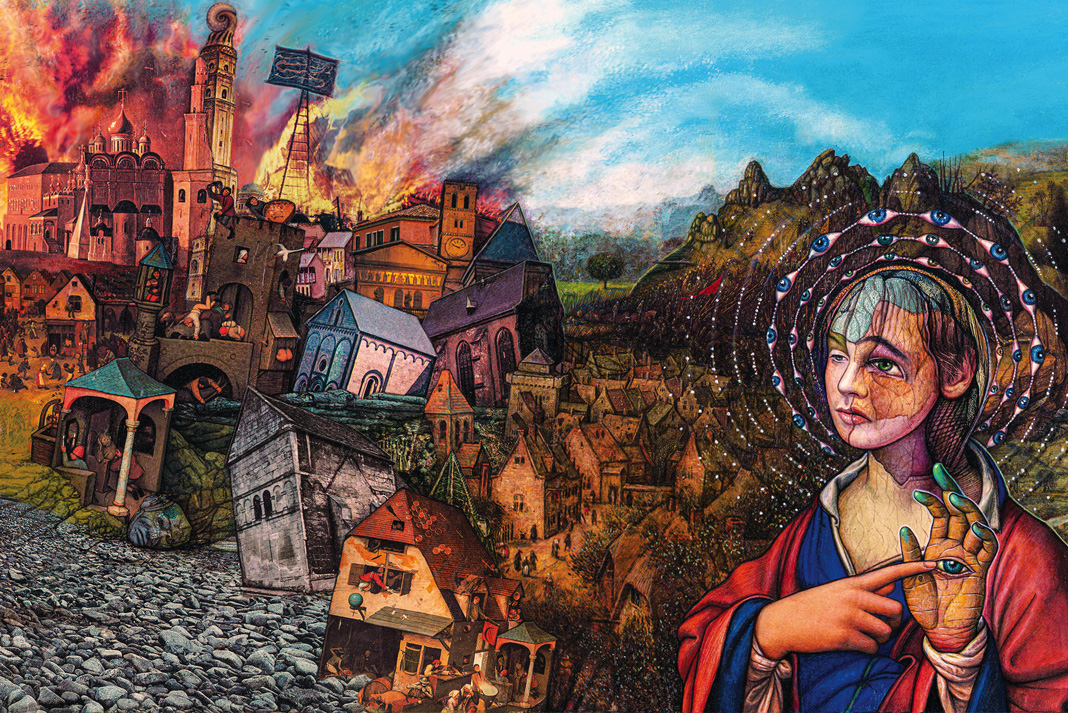
Too many. In addition to the artists I mentioned above, Alexa Meade, Miles Johnston and my favorite of all time is Pieter Bruegel the Elder.
Do you have any advice for artists just starting out or anyone wanting to get into the arts?
Just do it. Do not show anyone or tell anyone what you are doing. Just start and have fun. If you keep doing it, and notice that you are now obsessed with whatever it is that you are creating, then it is time to start sharing it with your friends. ALWAYS REMEMBER TO BE LIKE A CHILD. Do it because it is fun.
What piece, award, or exhibition are you particularly proud of, and why?
In 2021 I was one of 23 artists from the United States to be selected by the United States Embassy in Beijing, China for “Art for the People”, a public art exhibit showcasing street art from the United States in which murals were reproduced at life size on the exterior walls of the Embassy in China. (https://news.ecu.edu/2021/06/03/flying-fish/)
I know you’ll have a piece in the upcoming ROY G BIV exhibition, but where else can people find your work?
I have an exhibition April 5 – May 26, 2024 at the City Market Artist Collective, in Raleigh. And then I will have Solo Exhibit of new work at the Rocky Mount Imperial Center, September 10 – December 31, 2024.