

by Edward Ellis, Special Correspondent
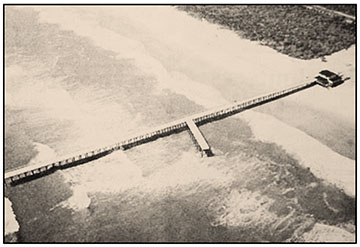
For many years, there was a fishing pier called the Iron Steamer on Bogue Island a few miles to the west of Atlantic Beach. The wooden pier was built over the wreck of a Confederate blockade-runner, the 224-foot-long, metal-hulled sidewheel steamer S.S. Pevensey.
In the summer of 1864, the Pevensey was on a smuggling run to Wilmington, N.C. from the island of Bermuda. Loaded with arms, blankets, shoes, silk, cloth, lead, and bacon, it got lost – set too far north by the currents of the Gulf Stream – and approached the U.S. coast near Beaufort.
An armed federal supply ship on Civil War blockade duty spotted the mystery vessel. It gave chase and fired on Pevensey seventeen times. At least one shell blew up on the deck of the Rebel craft before the captain decided to run her aground in hopes that he and his thirty-six-man crew might avoid prison.
Before abandoning ship, the huge steam engine – large enough to fill a modern two-car garage – was blown up by the crew. The smugglers, including three Confederate officers, were captured on the beach by federal cavalry from nearby Fort Macon.
And the ship that ran the Pevensey aground? Why, it was the USS New Berne, acquired by the Navy in 1862 and named in honor of the then-recent capture of this fair city by Union troops.
The illustration above is as close as we can come to the looks of the Pevensey. A photograph long misidentified as the ship still appears in internet searches but has been proven beyond doubt to be instead a Union steamer, the USS Mendota.
There isn’t an image of the USS New Berne either. We know the 195-foot New Berne was intended to be a supply ship. Rigged with sails, it was a wooden-hulled, propeller-driven steamer launched for the Union at New York.
Early in the war, the supply ship was shifted to the blockading mission aimed at restricting Confederate contraband. On the morning of June 9, 1864, New Berne proved to be a pretty good gunboat as well.
Eddie Ellis is the author of New Bern History 101 and other works about Craven County’s rich heritage. He can be reached at flexspace2@aol.com.