
By Claudia Houston, New Bern Historical Society
As July 4th approaches, interest in the Revolutionary War and New Bern’s role in it grows. What part did this coastal town play in the struggle for independence? New Bern was home to Loyalists and Patriots alike. In the wake of French aid arriving under General Lafayette, many French volunteers sought opportunities to serve in the American cause. New Bern became central to that effort.
Richard Caswell, a war hero who helped lead troops to victory at the Battle of Moore’s Creek and would later become the Governor of North Carolina, advocated for those French officers who came to his attention. He wrote many letters of recommendation to General George Washington so that these men might join the Continental line.
On April 24, 1778, Colonel Chariol de Placer received permission from the North Carolina General Assembly to organize a special regiment of State Troops, named the French Refugees Regiment. The plan was to recruit Frenchmen from across all states, but particularly North and South Carolina as well as the Caribbean. They were to be stationed in New Bern.
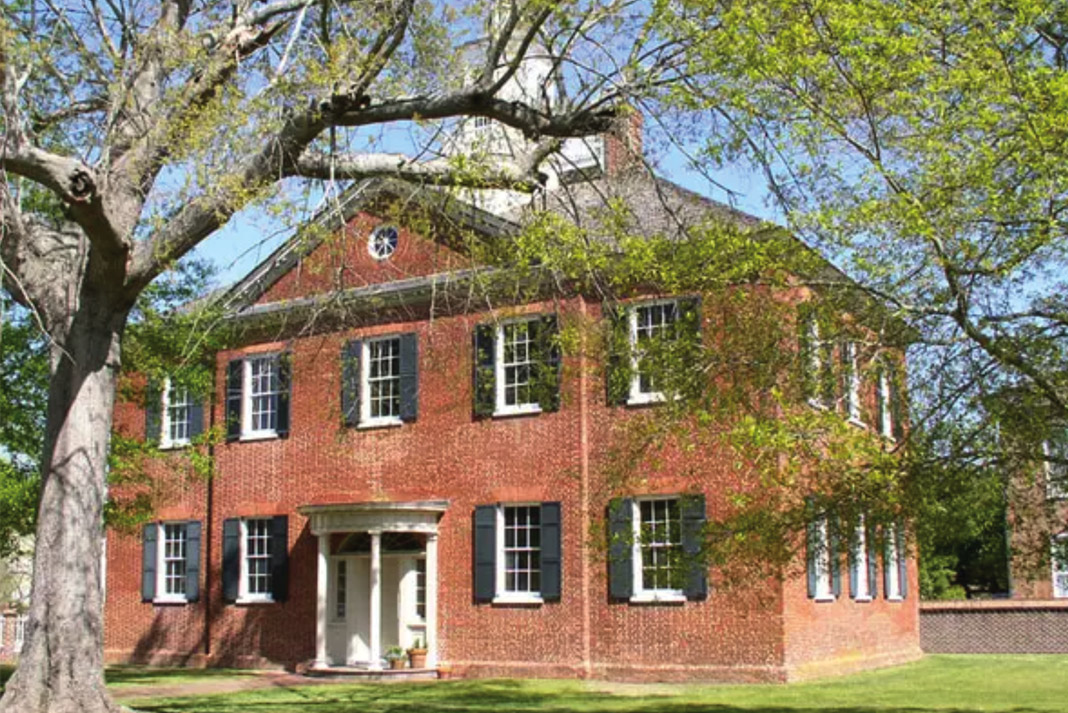
There were many French in the Carolina Ports, and few places for them to reside. The original Academy School in New Bern (built in 1766 and burned circa 1793) was not in operation as of May of 1778 and thus was used to house French recruits. The New Bern Academy building that is still standing, and is now a museum, was built on the same site and completed in 1810.
The. There was local resistance to this French unit in New Bern, and a recruiting incident led to armed crowds attacking Chariol’s men. The unit was never fully staffed, and by August 1778 was disbanded by the Assembly. Caswell, nonetheless, wrote to George Washington praising Chariol’s service and seeking other assignments for him, though it would appear to no avail as Chariol seemed to disappear from New Bern. It is unknown whether he returned to France.
One of the men tied to the French Refugee Regiment became involved with other Revolutionary War efforts. Captain James Mountflorence emigrated from France and joined the American efforts in 1778. While recovering from an illness, Mountflorence tutored local students in New Bern. After the dissolution of the Refugee Regiment, he offered his services elsewhere, and in 1780, he rose to the rank of Brigade Major under William Lee Davie in the North Carolina militia. He also became a delegate from Davidson County to the 1789 Fayetteville Convention, in which he voted yes to ratifying the Constitution. After the war, Mountflorence became a land agent and surveyor in Tennessee.
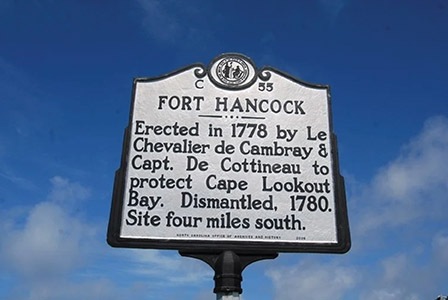
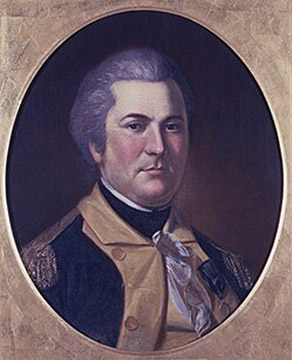
Another French officer, Louis Antoine Jean Baptiste Chevalier de Cambray-Digny, led efforts to fortify the coastal defenses in the Cape Lookout region by helping to build Fort Hancock. The North Carolina House of Commons commended Cambray-Digny on April 30 for his conduct and engineering of this fortification, and Caswell pressed Washington to consider him for the Continental Line. Cambray-Digny was commissioned as a Lieutenant Colonel and served as an engineer at Charleston and Savannah. He was captured in May 1780 and remained a prisoner until November 1782. He received an honorable discharge in November 1783.
There were several references that the South Carolina Assembly awarded Cambray-Digny a medal due to his help with fortifications during the 1780 siege of Charleston, but this fact could not be verified. Portrait artist Charles Wilson Peale painted Cambray-Digny in uniform, and his portrait hangs at the Independence Hall National Historical Park in Philadelphia.
New Bern’s wartime activity reveals a city navigating international alliances, a reminder that local histories echo global currents even in a quiet coastal town.