
by Edward Ellis, Special Correspondent
The 1802 duel between John Stanly and Richard Dobbs Spaight in New Bern was one of the most infamous political confrontations in the state’s early history. It brought together two men of different generations whose rivalry embodied the bitter partisan divisions of the young republic.
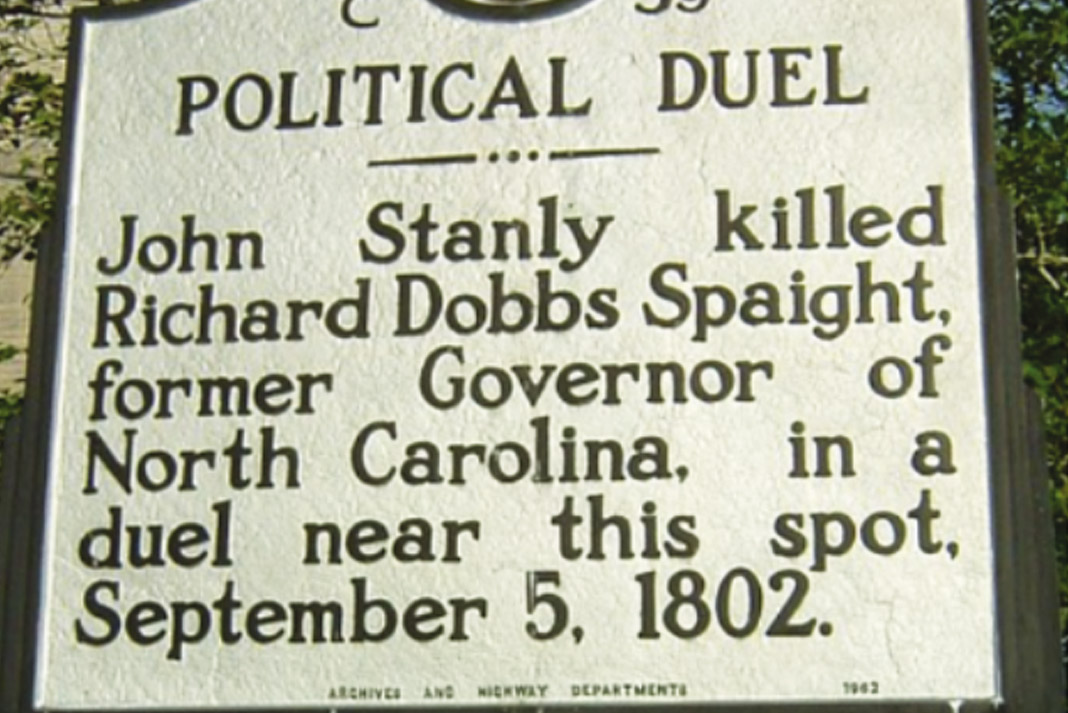
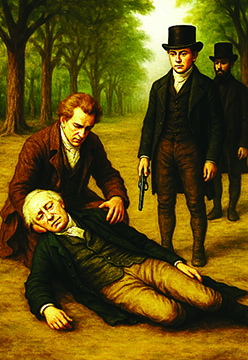
On the evening of September 5, following months of antagonism, the men and their seconds met behind New Bern’s Masonic Lodge. After several volleys, Stanly’s coat was pierced, but Spaight was struck in the side. The wealthy family man died the following day at forty-four.
Spaight had been born in New Bern in 1758. He was educated in Scotland and returned to America to serve in the Revolutionary War. He rose quickly in public life, represented the state in the Continental Congress, and became a signer of the U.S. Constitution in 1787. Spaight was the state’s governor from 1792 to 1795 and later a member of Congress. Though he began his career as a Federalist, by the late 1790s he had shifted to the Democratic-Republican Party, embracing Jeffersonian ideals of limited government. His stature as a statesman was immense, but his political shift left him vulnerable to attacks from former allies.
John Stanly, born in 1774, was nearly two decades younger than Spaight. A lawyer by training, he was ambitious, sharp-tongued, and fiercely loyal to the Federalist cause. Elected to Congress in 1801, Stanly earned a reputation for his biting wit and uncompromising rhetoric. His youth and energy made him a rising star, but also a dangerous adversary in the highly charged political climate of the time.
The feud was ignited by Stanly’s public accusations in the summer of 1802. He charged that Spaight neglected his public duties and insinuated that his votes could be bought. Spaight, who prided himself on his honor, considered these remarks intolerable slanders. The dispute escalated until Spaight issued a formal challenge to a duel.
The event shocked the country while illuminating the deadly consequences of pride and partisan rancor. The shootout is memorialized today by a historic marker on Johnson Street.