
By Shane Mason, Interpretation Coordinator
When you think of the Revolutionary War a few things are almost certain to come to mind. George Washington crossing the Delaware, the Minutemen, Paul Revere’s midnight ride, and British soldiers in their redcoats marching to battle. While each of these topics deserves a deeper dive, let’s take a closer look at the uniforms of the Revolutionary War.
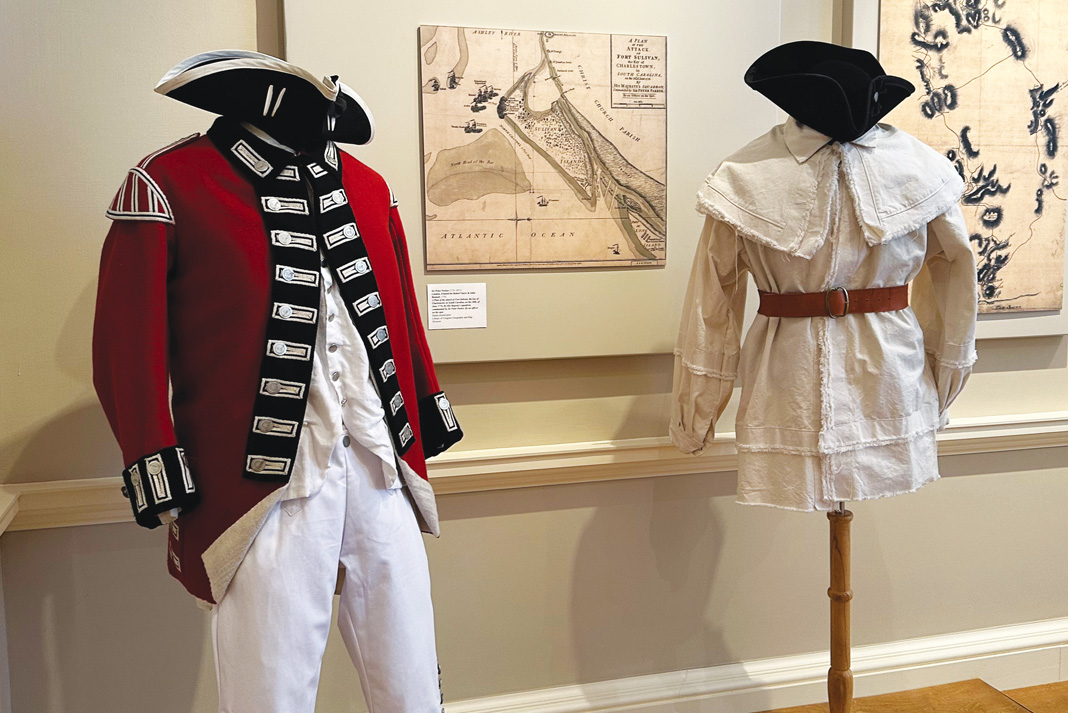
Where better to start than the British Redcoat? The British Army was broken into regiments of about 800 men when at full strength. Regiment coats were almost always red, but the facings or trim of the coat were different based upon their specific regiment. The 82nd regiment that occupied Wilmington, NC and raided New Bern and Kinston in August 1781, had red coats with black trim. During the French and Indian War, Governor William Tryon served with the 1st Foot Guards as a lieutenant colonel and wore a red coat with blue facings. The elite soldiers of each British regiment had their own marks of distinction. The grenadiers were made up of the largest and bravest men in the British army and were outfitted with distinctive bearskin caps to add to their fearsome appearance.
Washington’s Continental Army did not have the same level of organization that the well-established British army did. The militia, part-time and unorganized soldiers, often wore whatever bits of their civilian clothing was convenient. In 1776, Washington ordered them to wear hunting frocks to have at least some uniformity. The professional Patriot soldiers of the Continental Army were held to a higher standard. The Continental soldiers were supposed to have a standard regiment uniform based on the state they were from, but there were limited funds for provisions which made it difficult to uniform them in coats at all, let alone uniforms that matched. While the Continental Army endured the miserable winter at Valley Forge in 1777, a large shipment of much needed clothing came in from France. Included were brown coats with red facings and blue coats with red facings. Everyone wanted the blue coat with red facings that would become the classic uniform of the Continental soldier. A lottery was held at Washington’s Headquarters, and North Carolina, Maryland, New Jersey, New York, Massachusetts, and Virgina received the coveted blue coats that became known as the lottery coats. Continentals from other states would have to make do with the less striking brown coats with red facings.
Take the Caswell’s Capital tour as part of Tryon’s Palace Glorious Fourth celebration on July 4th to see the newly opened Revolutionary War Gallery featuring reproduction uniforms and maps from the American Revolution!