
by Edward Ellis, Special Correspondent
To the casual observer, New Bern’s modern qualities fail to suggest that it was once one of the most important seaports in the country. From the formation of the United States to the War Between the States, a staggering number of ships flowed continuously between the city and the major ports of the East Coast, Bermuda, the Bahamas, and the Caribbean islands.
Local merchants and townspeople watched daily for arrivals. The to-ing and fro-ing of these vessels was listed in each issue of the many newspapers published here. Shipowners and families of the sailors were particularly attentive, waiting anxiously for word of their small seaborne fortunes and cherished loved ones.
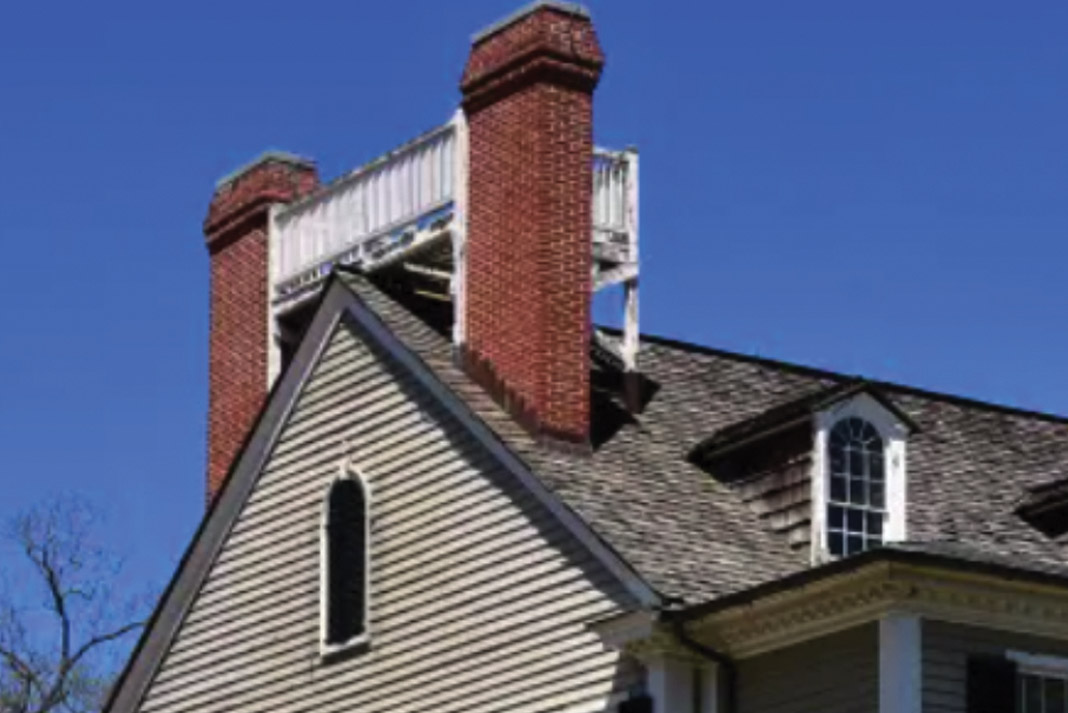
An artifact of these days is preserved atop several of New Bern’s historic homes: The “captain’s walk.” The color photo shows one at the 1830s Dixon House on the corner of Pollock and George streets. The rooftop-mounted structures provided a vantage point allowing a view many miles down the mighty Neuse River. From the high perch, a person with a spyglass might spot a ship just as it rounded Wilkinson Point – at today’s Minnesott Beach – some 15 miles downriver. The importance of such sightings is recalled by the fact that another common name for the lofty lookout was the “widow’s walk.”
Other examples are the Jerkins-Richardson House, circa 1848, at 520 Craven Street; the 1841 home of shipowner William Hollister at 613 Broad Street; and the Jones-Jarvis House, dating from 1810.
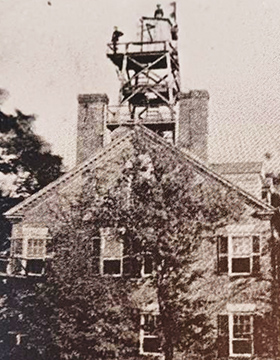
The black and white picture nearby is from local historian John Green’s book, A New Bern Album. It shows the Civil War-era “Crow’s Nest Signal Station” above the Jones-Jarvis home at the corner of East Front and Johnson Street. Green explained that the fastest way for the Union occupying force to communicate with the forts and troops around New Bern was with signal flags, lanterns, and flares. At this home, “Union engineers merely built a signal tower on top of the ‘captain’s walk’ already in place between the chimneys,” Green wrote. None of that structure survives today.
As romantic as is the idea of the lonely maid pacing the walk for a glimpse of the ship bearing her long-absent sea captain, the platform also allowed access to chimneys for cleaning or firefighting, and the occasional wooden shingle roof repair.