
by Edward Ellis, Special Correspondent
A crisis hit New Bern in the mid-1950s. The telephone company was running out of numbers! Word began to spread that the days of our simple four-digit dialing system were over! Melrose was coming!

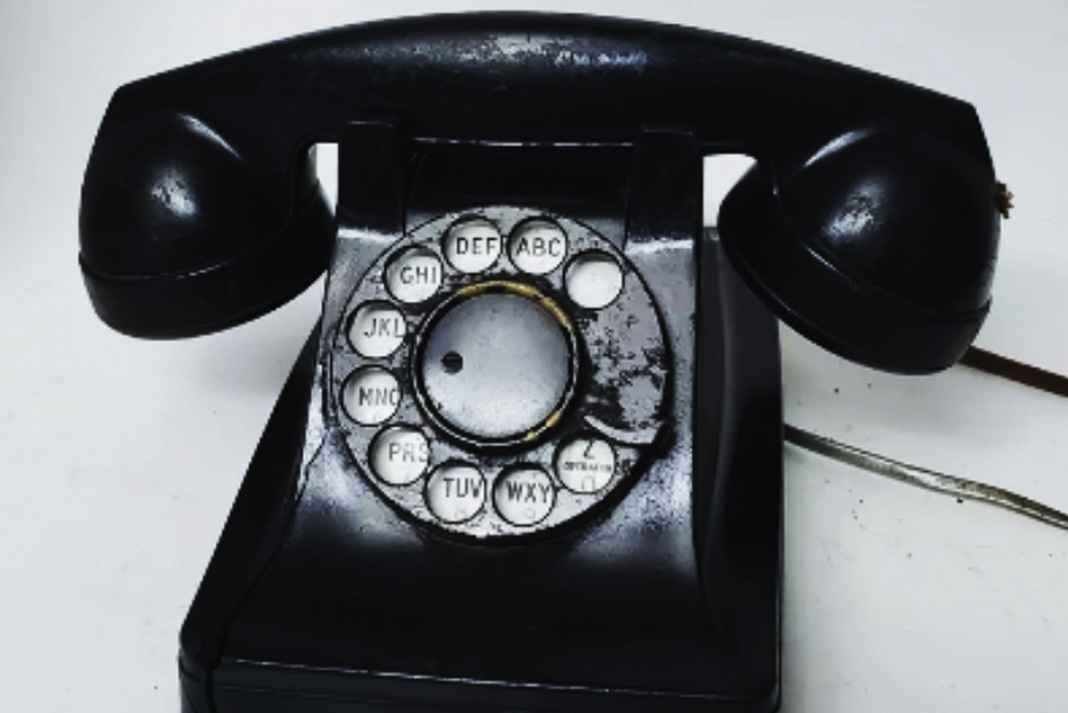
First, some background. One red-letter day when I was little, a friendly uniformed man came to our house in a brand-new subdivision called Trent Park on the very western edge of New Bern. He was there to wire us up for telephone service. When he was done, at our beck and call, was a big heavy black rotary dial phone that weighed enough to dispatch a wild animal, if necessary.
The rotary phone with a number and letter combination in each of its ten holes allowed us to dial anyone in town without bothering an operator. The ubiquitous operator was still there nevertheless and available by dialing zero. To make a call in those early days, you dialed just four numbers. With each digit, the phone rotor issued a ratchety-scratch noise as you waited for it to slowly return to its starting position. I still remember that a relative’s phone number was 4216.
Ours was a two-party line. Phones were expensive so the line was shared by two to four neighbors. You’d pick up the phone and listen. If someone was talking, you were supposed to hang up and try again later. If you kept quietly listening, you’d learn that their lives were as boring as yours.
So, what about Melrose? The way Carolina Telephone solved the number shortage was by adding a three-digit prefix. In New Bern, it was MElrose 7. The first two letters translated on the dial to 63, so the new prefix was 637, but often styled as it appears in the nearby 1958 drugstore ad from the New Bern Mirror.
We were relieved and overjoyed to learn that our busy lives would not be immediately burdened with dialing all three extra digits. Only the 7 had to be dialed at first. It was a couple of years before 637 was required to make calls. Little could we imagine then that somewhere in the bowels of phone company they were looking to the future and hard at work on something called the area code.