
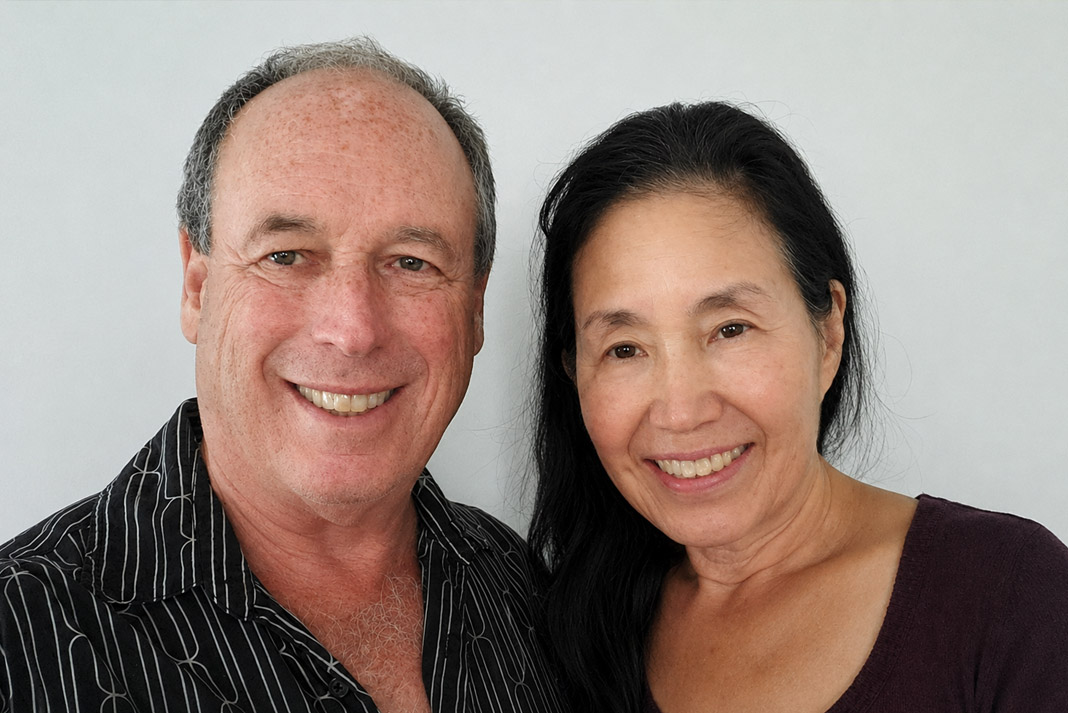
By Jonathan Burger, Craven Arts Council & Gallery, Inc.
Where are you from and how’d you end up in eastern North Carolina?
Kyung-I am originally from South Korea but came to America in the 1990s and met Steven. We lived in New Jersey, just outside of Manhattan but traveled each year on what we called “Art Trips” going out to the deserts of Utah, California and Arizona to paint, take photographs and write. We would also drive up and down the east coast from Acadia National Park down to the Florida Keys and many stops in between. We fell in love with the Outer Banks and New Bern and always knew when we retired it would be to North Carolina. It kept us close enough to our New York and New Jersey Galleries as well as the quiet rural life we wanted. The Art Councils in the area as well as the Watercolor Society of NC gave us assurance that we could stay active in art locally.
Do you have any formal training, are you self-taught, or a combination of both?
Steven-I studied at New York’s School of Visual Arts and later went on to teach life drawing there. Although I have formal training, my current work (almost a half century after graduating) is basically self-taught. Kyung and I paint daily and learn from just working in our mediums. Kyung studied creative writing in Korea and has been published both in Korea and in America. But being with me in the studio since the 90s, she began to turn her focus to the visual arts. So basically, we both learn from each other and certainly from our regular gallery and museum visits and conversations with other artists.
Does your work have a central theme, or several themes?
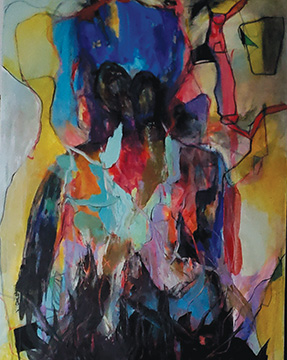
Kyung- My work is most certainly influenced by my Korean roots as well as my absence from my parents and siblings that I left behind, but I think both our work deal with spirits, melancholy, and the past. I feel there is a sensitive quality about our work. Steven’s work usually involved human rights, he did work about human trafficking including Comfort Women, Japanese internment camps and the Holocaust. But lately he carried that same somber mood into more personal work, paintings that deal with his own life. Both our work includes a little mystery and as someone else once put it, have a little touch of “Halloween” mixed in.
You and your wife are both artists, how is your work similar, and how is it different? Is there any combination of your work?
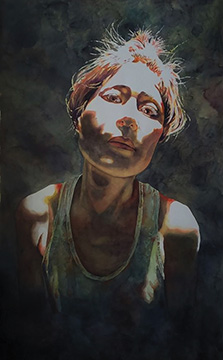
Steven-Kyung has been my model for many years and we occasionally paint the same subject in each’s own style. We are together all the time, discussing exhibitions we see, critiquing each other’s work and painting together in the studio. All current ingredients in my life are in her life as well. It is the past that, when evoked, brings out different images Kyung growing up in Korea and me in New Jersey. Our styles are very different, I paint in a somewhat representational style, she is an abstract expressionist, so the work is quite different yet has their roots planted in the same place, family and relationships. We both paint about family and death quite often. I think we both touch on those loved ones who are gone yet are never out of our lives. There is a mutual foundation in subject matter that comes out through different voices.
You work in several mediums and formats, do you have a favorite, and why (or why not)?
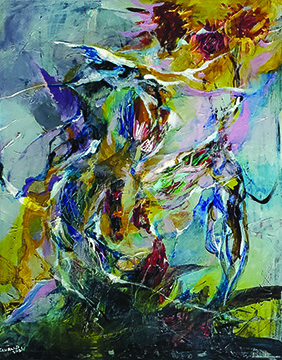
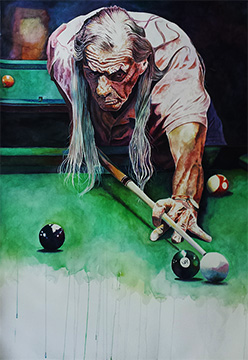
Kyung- I work in Acrylic and latex paint, Steven in oils and we are both watercolorists and members of the Watercolor Society of North Carolina. When working on canvas, there is a certain freedom of charging the painting with aggression, as I use several tools, knives, tree branches and roots to move the paint around. We both love the natural drips as the excess paint rolls down the canvas and the beauty of spontaneity. Watercolor is a more meditative medium for me. Although I am always free in whatever medium, I favor standing at the easel and action paint when I use acrylics. Even the music I listen to is faster and more aggressive when I am at the easel painting in acrylics. Disturbed, Rammstein, The Stones would be the playlist for a painting in acrylics, as Nick Cave, Tom Waits and Bob Dylan would dominate the playlist of a watercolor painting session. As for Steven, he is more at home in watercolor but loves the richness of the oils and uses layering in both mediums. Many of his watercolors are oversized 51×30 inch paintings, full of drips and splatters. His older work back in the 1990s was far more meticulous and almost strived for a photographic quality which no longer interests him, he would rather his watercolors look like a watercolor painting showing the washes and under drawing of the piece, as well as corrections made along the way.
Is there another artist whose work you admire or inspires you?
Steven-I love the work of Jenny Saville, Edward Povey and Cecily Brown, as well as South African artist Hari Laulhati and certainly Vincent Desiderio all of whom I follow closely. Kyung- Certainly Anselm Keifer is a favorite of mine as is Cecily Brown, but there are several gallery artists that have impressed and motivated me. An artist from New Jersey Kyung Youl Yoon is a wonderful abstractionist who paints large areas in gorgeous blues keeping the canvas light and free. My work leans to the darker regions, the somber and morose. But I am certainly drawn into these other approaches and find inspiration.
What one piece, award, or exhibition are you particularly proud of, and why? Kyung- Two years ago we had an exhibition at the Belskie Museum in Closter NJ titled Past Addresses. We were curious and somewhat apprehensive as we had moved from New Jersey to North Carolina quite some time before. We weren’t sure if we still had an audience up there. However, the reception was like a homecoming celebration. Friends, relatives, curators, artists and art collectors all came to see what we were painting five years after leaving the area. We both had sales and it was a most memorable time. Steven-I did many series on human rights and more specifically on forms of human trafficking. I painted a series of large 51” portraits of victims of the Japanese Internment Camps. These paintings were exhibited at Manzanar National Historic Site, and titled Looking Back, Seeing Ahead, about the Japanese Americans that were interned there during WWII. They were oversized portraits with a quote at the bottom of the watercolor given to me by each person I painted. At the reception, 12 of the people I painted attended and about 7 more came during the duration of the show, it was scheduled for a six month run, but it was extended to a two year show. It hung in their visitor’s center from 2017-2019 and came down just before the covid shutdown.
What advice do you have for other artists, or those wanting to get into art?
Steven- Be yourself, say what you have to say and never doubt your own voice. Artists are always surrounded by people who don’t understand their work and set out to discourage them. Just believe in yourself and create, never stop making art. Kyung- Paint with emotion, don’t overthink the work, just let it flow, throw caution to the wind.
I know you’ll be having an exhibition at Bank of the Arts, but where else can people find your work?
Kyung- We will be exhibiting together in a two person show in New Jersey at the Riverside Gallery in Hackensack this September and always involved in the Jacksonville Council for the Arts. We are now members of the Craven Arts Council, so hopefully we will be contributors to future group shows. My work can be seen on Instagram at kyung.cavallo.paintings, and on Facebook at Kyung Cavallo as well as Youtube under Cavallo watercolors. Steven-When I moved to NC, I let my website expire, but honestly, I hadn’t updated it in over a year. I keep both Facebook and Instagram current and my work can be seen at Steven Cavallo on both social media platforms.