
Anthony Giardino, Executive Director, New Bern Historical Society
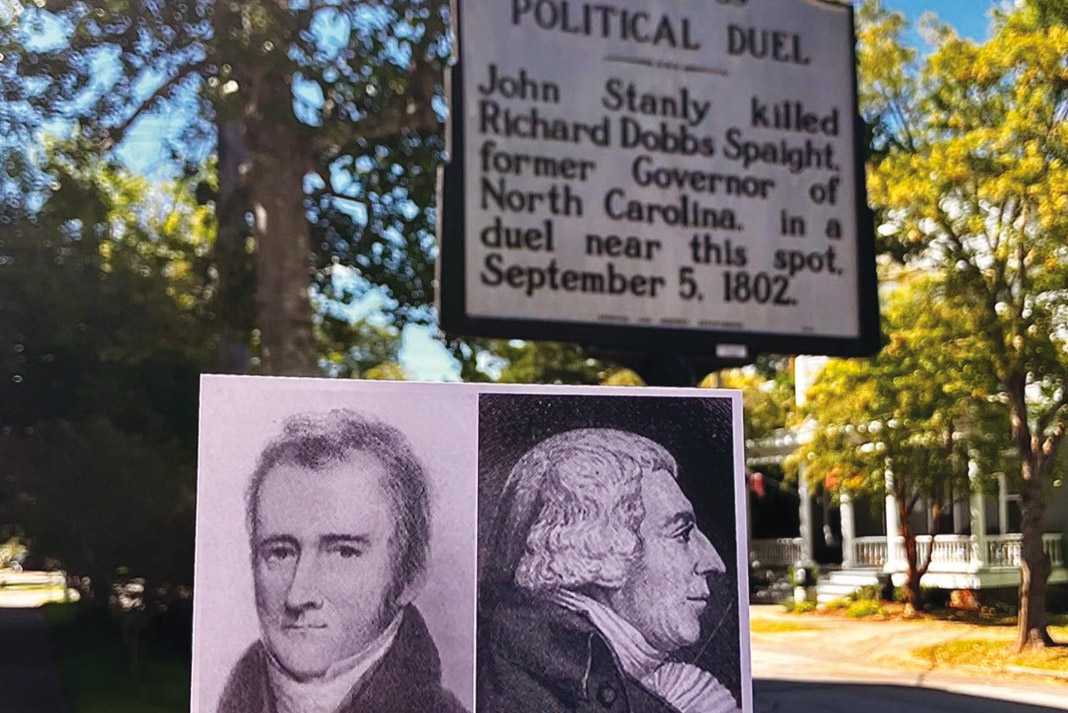
September 5th marks the anniversary of New Bern’s infamous political duel. On that day in 1802, political rivals John Stanly and Richard Dobbs Spaight took matters to the streets of New Bern in defense of their honor. Spaight had lost his Congressional seat to Stanly in 1800, and for two years both men exchanged heated words published on handbills and in the “New Bern Gazette.” Stanly and Spaight arranged their fateful meeting behind the Masonic Hall at 5:30 PM that day and brought along their pistols. It is rumored that there were close to 300 spectators present.
For three rounds, both men missed their targets. Then, Congressman Stanly, age 28, shot the former Congressman and Governor Spaight, age 44, in the side on the fourth round. Spaight died of his wounds the next day. Governor Benjamin Williams pardoned Stanly from any legal prosecution. The outrage from the population of the state, however, led the General Assembly to pass a strict law against dueling.
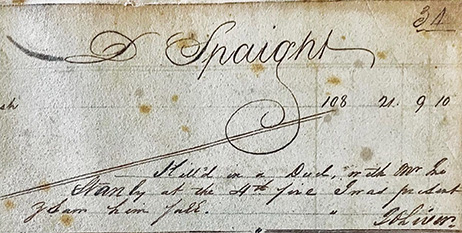
In the Historical Society collection, we maintain this remarkable handwritten entry from the John Oliver ledger. New Bern merchant John Oliver carefully documented his business transactions in a leather-bound ledger from 1790 to 1805. The entries regarding the customer account of Richard Dobbs Spaight are noteworthy. John Oliver was present on September 5th and witnessed the duel. After the death of Gov. Spaight, John Oliver made an entry in his business ledger to formally close Spaight’s account. Oliver wrote:
“Kill’d in a duel with Mr. Jo Stanly at the 4th fire. I was present and saw him fall.
J Oliver.” This entry appears to be the only documented eyewitness account of the duel.
The 1802 duel between John Stanly and Governor Richard Dobbs Spaight remains North Carolina’s most famous political duel and stands as a powerful reminder of an era when personal honor could outweigh reasoned political debate. Although dueling continued in parts of the South for several decades, public opinion gradually shifted against the practice as its tragic consequences became increasingly apparent. By the mid-nineteenth century, stronger laws, changing social attitudes, and a growing expectation that elected officials should resolve their differences through public discourse rather than violence brought the age of political dueling in North Carolina to an end. Today, the Stanly–Spaight duel serves not as a celebration of honor, but as a cautionary chapter in the state’s political history. [Historical Marker C39, near intersection of Johnson and Hancock Streets by County Library]