
by Edward Ellis, Special Correspondent
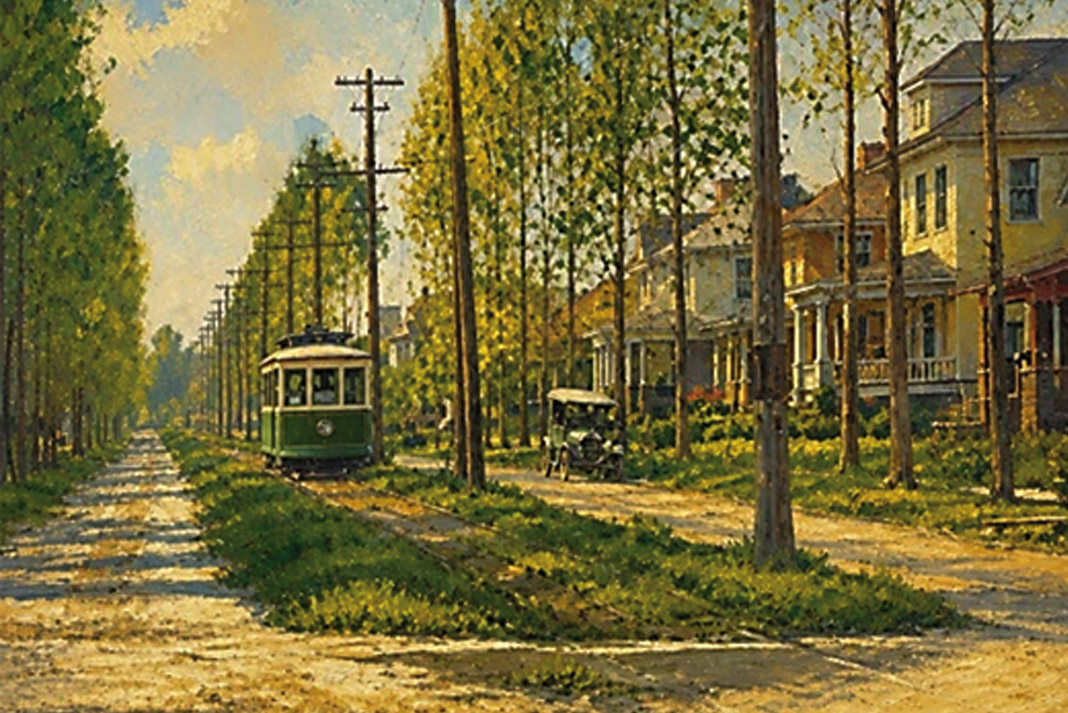
Before automobiles reshaped New Bern, a trolley helped create one of the city’s most distinctive neighborhoods.
In 1912, a group of local and Virginia investors organized the Ghent Land Company to develop what was then largely outlying property. But they understood that selling a new suburb required more than streets and houses. It needed transportation. So, at virtually the same time, they organized the New Bern-Ghent Street Railway.
The strategy was simple: build the neighborhood, then connect it to downtown.
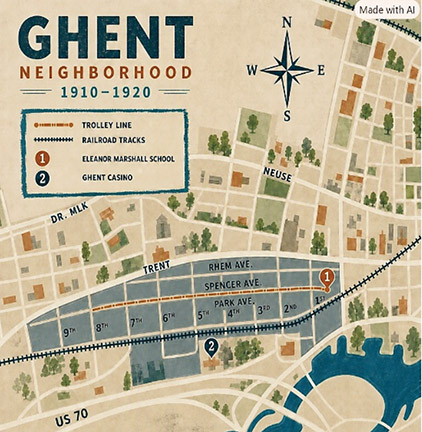
The trolley began operating in early 1913, running from the business district through Pollock Street and Spencer Avenue into Ghent. Its first three cars were storage-battery vehicles; the system soon became conventionally electric. In its first year, the railway carried thousands of passengers with just nine employees.
For Ghent’s residents, the streetcars were more than a convenience. They made suburban living practical. A resident could live in a new house in Ghent and still easily reach downtown for work, shopping, or lunch. Children could ride it to school. At the end of the line, Ghent Park offered recreation. The trolley wasn’t merely serving the development—it was part of the development’s business plan.
The connection was unusually direct. Fritz Sitterding, a Virginia businessman with railway interests, was a principal investor and served as president of the street railway. Ernest Armstrong and Callaghan McCarthy, prominent New Bern businessmen, were also deeply involved. The same interests that sold Ghent helped provide the transportation that made it attractive.
For roughly sixteen years, the trolley became part of everyday New Bern. Then the automobile changed the equation. By the 1920s, rising car ownership was undermining street railways across America. New Bern’s trolleys made their final runs in 1929.
Yet the concept lingered. The rails reportedly remained in the streets until 1939, and traces of them still survive beneath New Bern’s pavement. On Spencer Avenue, the broad median occupies what was once the trolley’s right-of-way.
The New Bern trolley is, therefore, more than a forgotten transportation story. It is a small, vivid example of how some American cities were once built around streetcars—and how quickly the automobile swept that world away.