

by Edward Ellis, Special Correspondent
If you’ve ever wondered how New Bern went from “a few dozen folks swatting mosquitoes” to “the largest town in North Carolina for a hot minute,” buckle up. This is the story of a small colonial settlement that grew steadily, stubbornly, and sometimes surprisingly — like a determined azalea in a hurricane.
We begin in 1710 when a couple of hundred sea-weary Swiss and Germans straggled in to join settlers scattered along the Trent River. By the 1760s, New Bern boasted “approximately 500 residents and 100 houses,” according to colonial records. That may not sound like much today, but in the 18th century, it was practically a metropolis. By comparison, many nearby settlements were still arguing over who forgot to bring nails for the meetinghouse.
Fast‑forward to around 1791, when observers noted the town had “about 400 houses.” No one bothered to count the people — census‑taking was still in its awkward adolescence — but 400 houses meant New Bern was thriving. Then came the 1800 federal census, the first time the government officially asked, “So… how many of you are there, exactly?” The answer: 2,467. A respectable population, and enough to make other towns glance over and mutter, “Well, look at New Bern getting all fancy.”
From there, the numbers marched upward with the determination of a spot that refused to be anything less than interesting: 1820, 3,663; 1850, 4,681; 1860, 5,432; 1890, 7,843. That’s nearly 8,000 people by the end of the century — despite wars, fires, storms, epidemics, and the occasional political drama. The place just kept growing, like it had something to prove.
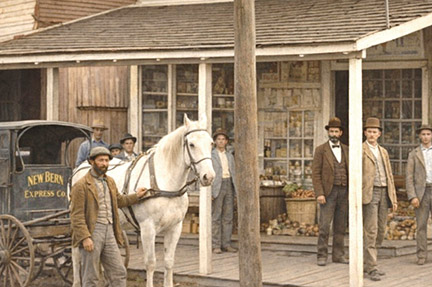
By the 1890s, New Bern had transformed from a modest colonial capital into a bustling river port – and the birthplace of Pepsi-Cola – with enough residents to support shops, schools, newspapers, and at least three people who insisted they remembered when “this whole place was just pine trees.”
For much of this writer’s life, the count was stuck around 15,000. Today, it’s bumping up against 35,700, a jump of at least 14 percent since the last federal count in 2020. Fancy, indeed!