By Jonathan Burger, Craven Arts Council & Gallery, Inc.
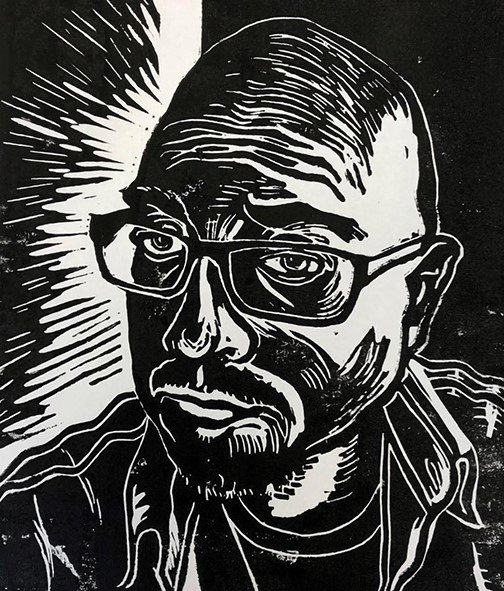
Where are you from, and how’d you end up in eastern NC?
I’m originally from Milwaukee, WI. We moved to NC when I was in high school; my father accepted a position teaching sculpture at UNCGreensboro. He later took a position as head of the sculpture area at ECU in Greenville. I stayed in Greensboro to complete my MFA in painting/printmaking, and then accepted a full-time teaching position at Cape Fear Community College in Wilmington, NC. I retired after teaching for CFCC for 25 years, and am now the Curator of Exhibitions and Collections at the Cameron Art Museum in Wilmington.
Do you have any formal training as an artist, are you self-taught, or a combination of both?
My father is a sculptor, my mother is a weaver, and her father was a painter, printmaker, and ceramicist. I learned a lot from each of them as a child (and I’m still learning from them to this day). As a kid, I was around a lot of other professional artists. Sometimes I compared my fledgling work with that of the professionals around me, and that made me briefly question whether I had enough skill to pursue art as a full-time career. I actually had two really great art teachers in high school who helped me rediscover my own approach to the creative process. That gave me the confidence to enroll in the BFA program at UNCG, where I studied with painters Wally Barker, Bill Collins, and Bert Carpenter, and printmaker John Maggio. When the opportunity for scholarship/assistantship funding for graduate school arose, I knew I needed to continue my MFA studies at UNCG. In graduate school my assistantship was in the art history department; art history remains a passion of mine.
You are a printmaker, what about that medium appeals to you?
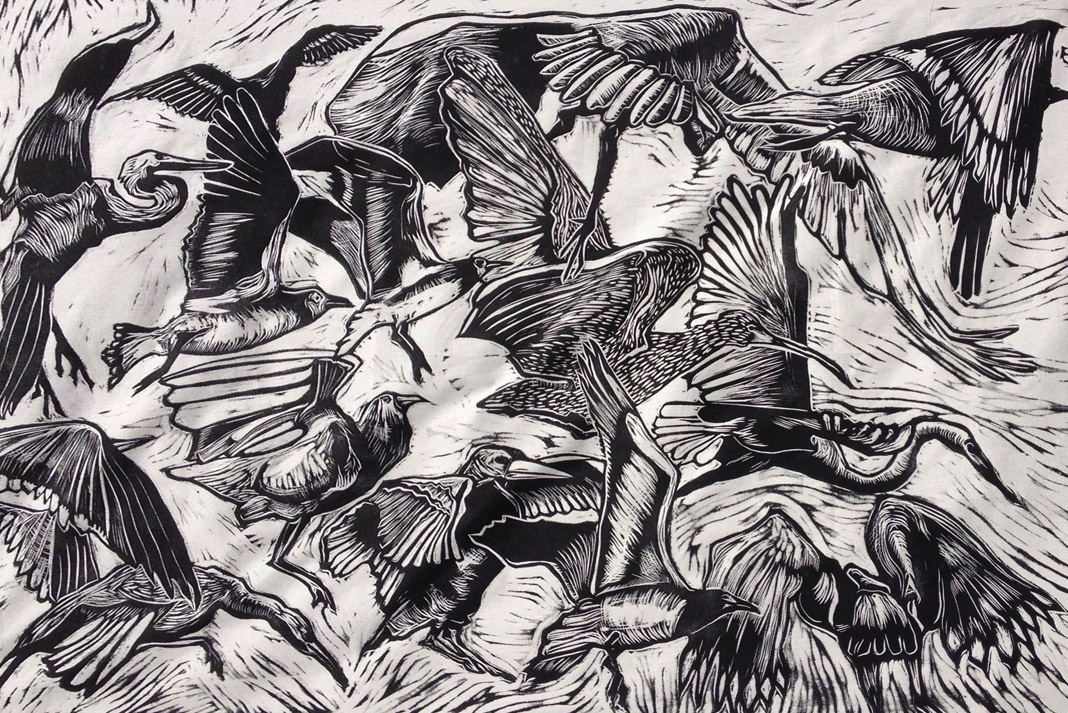
My focus in school was primarily painting, but I always found myself drawn to printmaking. When I joined the faculty at CFCC, we were in the process of establishing an art program with an associate’s degree. This gave me the opportunity to focus on printmaking and art history in my teaching. Over several years we acquired both an etching press and a lithography press, so I was able to introduce students to the wide range of techniques available to printmakers. I love the problem-solving aspect of printmaking, the planning and step-by-step process of creating an image. I like the challenge and surprise of not knowing exactly what the end result will be until you pull your first proofs. Most of all, though, I love the collaborative nature of printmaking. For about the last decade, I’ve been participating in large-scale (four foot by six foot) woodcut printing events where we print images on fabric using a steamroller. My students have done team-blocks at these events, but many who have graduated are now organizing events of their own!
Does your work have a central theme, or several themes?
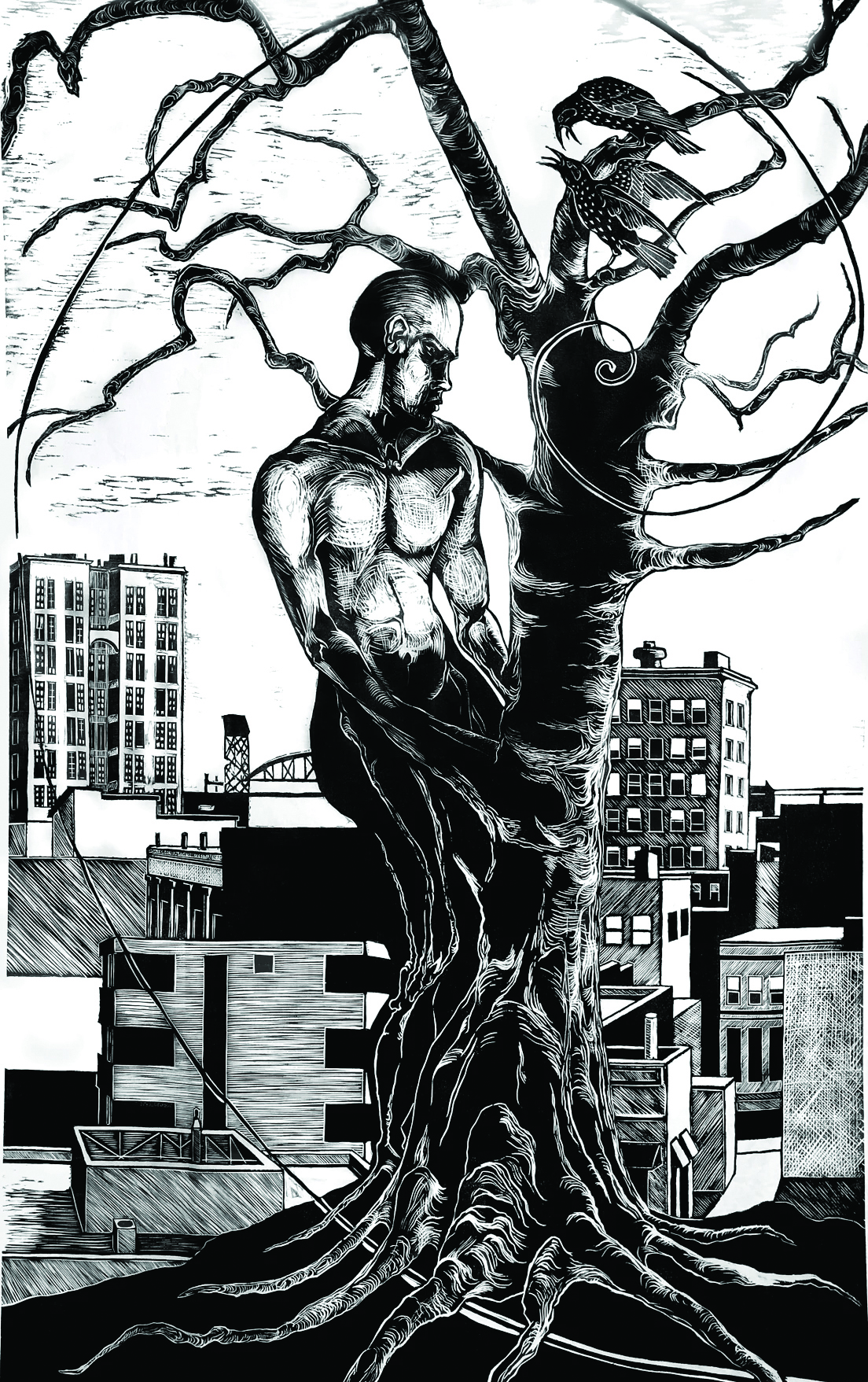
My paintings tend to be abstractions based on my initial visual impressions and reactions to everyday scenes. They’re usually figurative or landscape subjects. In my prints I use more symbolism, narrative, and a somewhat surrealist approach to space to focus on my lived experience as well as the theme of humanity’s relationship to the natural world.
You are also a curator. What relationship do you see between your work as an artist and as a curator?
I have loved doing curatorial work throughout my adult career. I see a definite connection between creating narratives in my prints and telling larger stories through my selections of works in group exhibitions. The “art history nerd” in me loves the research aspect of preparing an exhibition, and the “retired teacher” part of me loves giving tours and lectures. To me, visual art is a highly sophisticated form of communication, and as a curator I have the privilege of sharing the messages of artists past and present with entirely new audiences.
Is there another artist whose work you admire or inspires you?
My biggest inspirations in painting are Henri Matisse (and the other Fauves) and Richard Diebenkorn (and the other Bay Area Figuratives). I love the prints of the German Expressionist movement (especially Käthe Kollwitz) as well as contemporary printmaker LaToya Hobbs. I get a lot of inspiration from my former students, to be honest, and I love continuing to print alongside them as they embark on their professional careers.
What one award, piece, or exhibition are you particularly proud of, and why?
I will always treasure my 2006 Marilyn Goodman Anderson excellence in teaching award, but most recently, I’m really proud of the Fresh Air: Inflatable Sculpture exhibition on view at the Cameron Art Museum in Wilmington, NC through September 06, 2026. This show features a historical anchor, Andy Warhol’s Silver Clouds (displayed in their own gallery so that viewers may interact with the “clouds”) and a contemporary, Covid-era piece, Augment, by Nick Cave. Not only does this show allow us to see the evolution of inflatable sculpture, but it provides an opportunity to showcase a number of remarkable contemporary women artists including: Claire Ashley (born in Scotland), Nicole Banowetz, Nancy Davidson, Tamar Ettun, and Momoyo Torimitsu (born in Japan). These pieces are not only deeply meaningful but are also joys to look at. Watching both actual kids and grown up kids react to art with surprise, happiness, and curiosity makes me ridiculously happy.
What advice do you have for other artists, or people wanting to get into the arts?
My advice for aspiring artists is to keep showing up and keep saying yes. We face a lot of rejection in this business, and you have to accept that while continuing to put yourself out there. Success may not be immediate, but hard-work and dedication tend to be recognized. I accepted every volunteer or low-earning art related opportunity I could get my hands on, and those early smaller projects usually led to larger projects. I think it was Sol LeWitt who said “Work makes work.”
In one sentence, what is art to you?
Art is a highly sophisticated form of non-verbal communication, reliant on our shared humanity, allowing for a variety of interpretations and responses.
I know you’re the juror for the 2026 Bank of the Arts National Juried show, but where can people see your work?
I currently have prints in Sweet Relief a group show at ACME Art Studios in Wilmington. I’ll be installing a three-person family show at Pedvale Open-air Art Museum in Sabile, Lativa this July. You can always find me on Instagram – @benjamin_billingsley_art