
by Tryon Palace Staff
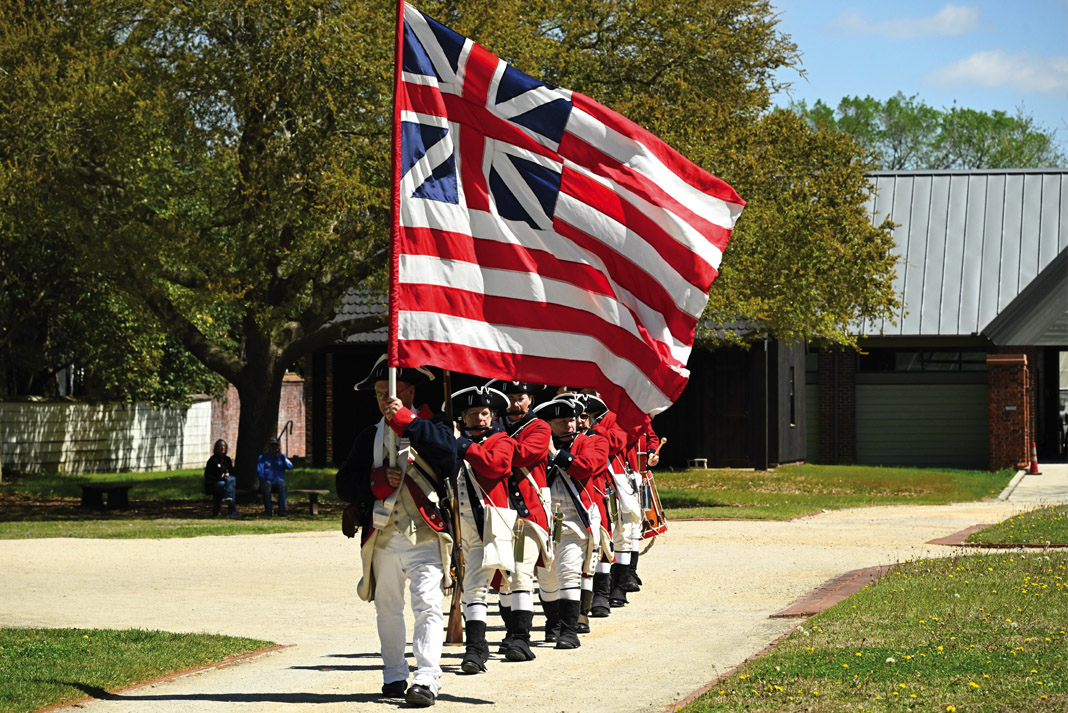
When Tryon Palace decided to honor America 250 with hand-sewn replicas of the earliest recorded North Carolina musician uniforms, the flag had to match. Tryon Palace Historians knew, for 1776, the earliest American flag was needed. They needed The Grand Union Flag.
Also known as the Great Union, Somerville, Cambridge, or Continental Flag, this flag—as with many things in early America—found its origins in Britain. The sovereign flag of Colonial America was the British Grand Union ensign. An “ensign” was a maritime flag flown on a vessel to indicate its nationality. The British Grand Union ensign consisted of a large red field with a union jack in the upper corner canton.
To create a new flag—an American flag—Patriot flag makers interspersed six white stripes within the British Grand Union’s red field. These stripes became the iconic 13 red and white stripes that symbolize the unity of the colonies. To replicate the flag, Tryon Palace historians found period depictions of the flag on powder horns, ship paintings, and a North Carolina seven-and-a-half Dollar note—issued April 2, 1776—to determine an accurate design for the recreation.
Next, Tryon Palace Historic Costumer Ericka Osen sorted out the specifics of this 18th century design. The Continental Army used British regulations for most things, including flag sizes. To be accurate, the new flag needed a 6-foot hoist—the side along the flagpole—and a 6-foot 6-inch fly—the length of the flag that flows freely. British military flags were usually handsewn using high-quality silk, so the replica would be as well.
The Tryon Palace Grand Union Flag is of regulation size and material, and it was handsewn by Osen and her team of volunteers. The flag is now carried by the newly outfitted Fife and Drum Corps as Tryon Palace celebrates this Semiquincentennial year.
It is widely believed that General George Washington raised the Grand Union Flag over the Continental Army encampment at Prospect Hill in Charlestown (now Somerville) near his headquarters at Cambridge, Massachusetts on January 1, 1776. Fittingly, the recreation made its debut during the First Oval Office Project event in March, alongside a reproduction of Washington’s tent.